

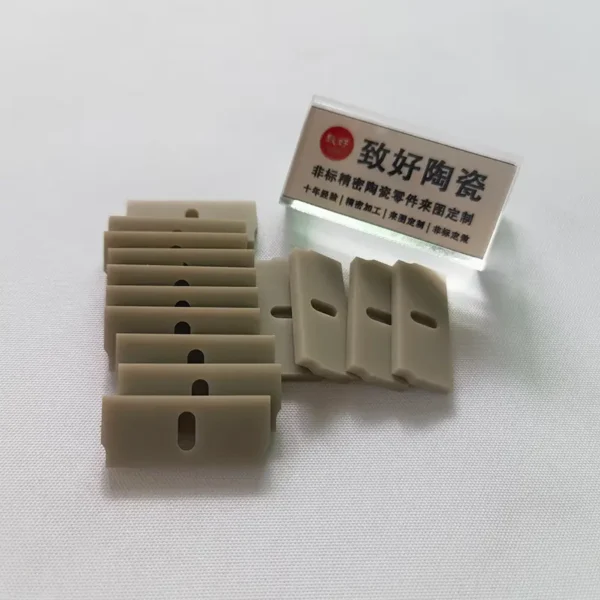

Prepare the inquiry around lengthwise straightness, width, thickness, edge quality, surface condition and any holes, slots or deposited features. Aluminum nitride may be selected for a demanding assembly, but no assumed thermal, electrical or mechanical value should replace a verified requirement. Ask suppliers to state material assumptions, inspection methods, process limitations and quotation exclusions clearly.
Key Inquiry Requirements
Start with the strip’s function and orientation
Explain how the strip is installed and what its long axis must accomplish. It may act as a support, spacer, insulating member, guide or interface element, and each role changes the importance of bow, twist, edge contact and surface loading. Show the datum faces, orientation marks, contact zones and any clamping or bonding areas directly on the drawing.
Identify whether the strip is used singly, in a repeated array or as part of a larger ceramic assembly. State the mating materials, joining method and loading direction so the supplier can evaluate edge treatments and handling risks. If the component is later cut, coated, metallized or assembled into a stack, include those downstream operations in the inquiry.
Control the long-strip geometry
For a long ceramic strip, overall length alone does not describe fit or function. Define width, thickness, straightness, parallelism, flatness, twist and end squareness where those characteristics affect installation. Establish datums and measurement spans, and distinguish total allowable variation from local variation. This gives quotations a practical basis for reviewing forming, sintering, grinding and finishing steps.
Uniformity along the length should be translated into measurable drawing requirements. Mark the zones that are functionally active and specify whether ends, corners or transition areas are excluded from critical measurements. Avoid unsupported claims about precision; instead, request the supplier’s proposed process capability or inspection plan against the characteristics that actually determine assembly performance.
Specify edges and surfaces for real assembly conditions
Edges may contact another ceramic, a metal frame, a seal, a fixture or a delicate neighboring component. Define chamfers, radii, edge breaks, chips and cracks according to that interface. If an edge remains exposed, include handling and safety considerations; if it is buried in a joint, explain the joint design so the finish is not over- or under-specified.
Surface requirements should identify the functional face, roughness or texture needs, cleanliness, allowable marks and any coating or metallization. A straight-looking strip is not automatically suitable for bonding or thermal contact. Ask for representative inspection images or sample review when appearance is important, while retaining measurable criteria for formal acceptance.
Review material selection without assuming values
Aluminum nitride should be evaluated against the complete environment: temperature cycling, electrical isolation, contact pressure, joining chemistry, cleaning agents and handling method. The RFQ should identify which properties are design inputs and how they will be verified. Do not substitute a catalog data point for a requirement unless the value, test method and acceptance range are explicitly agreed.
If the strip will be machined or finished after firing, ask suppliers to describe the proposed route and any limitations around thin sections, narrow edges or small features. A buyer can then compare quotes on process risk, yield assumptions and inspection coverage. Material identification, lot definition and documentation expectations should be stated independently from the desired component geometry.
Make the quotation comparable
Send the supplier a controlled drawing, revision history, estimated quantity basis, sample requirements and intended use. Include the packing orientation, separator material and cleanliness expectations if the strips must arrive without edge contact or contamination. Ask for written identification of deviations, substitutions, unquoted features and any dimensions that require clarification before production.
A useful comparison checks whether each response addresses lengthwise geometry, edge quality, surface preparation, material evidence, inspection and packaging. It should also reveal whether the quoted route is based on cut blanks, formed strips, ground parts or another process. The objective is an auditable technical discussion, not an assumption that a visually similar strip meets the buyer’s design.
Questions Before You Inquire
Which dimensions matter most for an aluminum nitride strip?
The important dimensions depend on installation, but buyers commonly need to define length, width, thickness, straightness, flatness, parallelism, twist and end condition. Add datums and measurement spans. If the strip contacts a seal, fixture or thermal interface, specify the related surface and edge controls rather than relying on overall size alone.
Should long-strip straightness be specified globally or locally?
Usually both may matter. A global requirement controls the overall path relative to a datum, while local measurements can protect contact or mounting zones. Divide the strip into functional areas and state the measurement method. Suppliers should confirm how their proposed process and inspection plan address each defined characteristic.
What surface information belongs in the RFQ?
Identify the functional faces, roughness or texture, cleanliness, allowable visual marks, coating or metallization needs and edge limitations. Explain the bonding, clamping or thermal-contact process that follows. This context helps a supplier propose an appropriate finish and prevents a vague appearance requirement from being interpreted inconsistently.
Does aluminum nitride automatically guarantee thermal performance?
No. Material selection alone does not establish the performance of a finished strip in a particular assembly. Geometry, grade, interfaces, joining method, contact pressure and operating conditions all matter. Define the required property, test basis and acceptance range in the project documentation, then ask suppliers to provide relevant evidence.
Send a Clear Component Brief
Share your drawing, quantity and application with Porcecore. Mark the requirements that are fixed and the questions that remain open.


Reviews
There are no reviews yet.