

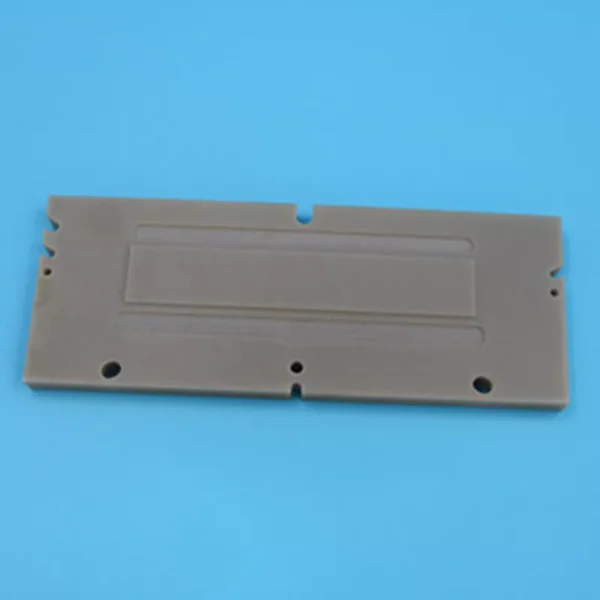

Define the pad as an engineered part rather than a generic sheet. The RFQ should identify the assembly location, heat-source and heat-sink interfaces, compression or mounting method, electrical isolation needs, operating environment, edge treatment and inspection expectations. Provide a dimensioned drawing, three-dimensional model where available, marked datum scheme and any process constraints that could affect fit, flatness or surface condition.
Key Inquiry Requirements
Thermal pad geometry and interfaces
The pad’s value is determined by how it sits between defined mating surfaces. Buyers should show the contact outline, keep-out zones, holes, slots, corner radii and any stepped or relieved regions. The drawing should distinguish functional surfaces from non-critical edges, identify datums and state how the part is located during assembly. This information helps separate thermal-path requirements from packaging or clearance requirements.
Describe the interface stack, including adjacent materials, contact pressure, fastening arrangement and any compliant layer used with the ceramic. If the pad must remain electrically isolating, state that requirement as part of the assembly specification rather than leaving it implicit. Ask for review of potential stress concentrations, unsupported spans and handling risks associated with the proposed geometry before finalizing the RFQ.
Material definition and design review
Aluminum nitride should be specified as the intended material family, while the buyer defines the properties that are actually critical to the application. These may include thermal behavior, dielectric requirements, mechanical handling limits, surface condition and compatibility with neighboring materials. Avoid relying on a generic material label alone; request confirmation of the proposed grade or material route against the approved drawing and use case.
A useful technical exchange compares the required function with alternative ceramic families only when the assembly permits substitution. The comparison should consider heat flow, electrical isolation, geometry, joining method, handling and inspection—not a single headline value. Include the operating envelope, duty cycle and environmental exposure so the proposed pad can be evaluated against the complete system context.
Drawing, tolerances and inspection
State every dimension that controls installation, contact and clearance, then identify which dimensions are reference-only. The drawing should define tolerances, datum references, flatness or parallelism requirements where needed, surface-finish expectations and treatment of edges, chips or visible marks. If a value is not important, do not create an unnecessary acceptance criterion that complicates comparison between quotations.
Inspection planning should match the component’s actual risks. Explain which features require dimensional verification, visual examination or documentation, and identify the measurement method when it affects interpretation. For thin or delicate pads, also discuss packaging and handling during inspection. A complete RFQ lets suppliers flag manufacturability concerns before quotation and gives the buyer a consistent basis for incoming review.
Assembly and process considerations
Explain how the pad will be installed, supported and retained. Include clamping sequence, allowable contact materials, cleaning expectations, thermal interface materials, joining or bonding steps and any post-assembly process. If the ceramic is exposed to vacuum, reactive atmosphere, cycling or repeated maintenance, describe those conditions without assuming that a material name alone resolves them.
The RFQ should also identify whether the part is used as a one-off prototype, a design-validation article or a recurring production component. Buyers can request a manufacturability review focused on corners, narrow ligaments, holes, thickness transitions and handling points. These details help align the proposed fabrication route with the drawing and reduce ambiguity during sample evaluation.
What to include in the RFQ
Send the latest controlled drawing, revision level, three-dimensional model if useful, annual or project quantity range, intended application, mating-part information and acceptance criteria. List any required documentation, packaging controls, traceability expectations or sample inspection reports. Separate mandatory requirements from preferences, and mark all values that remain open for supplier discussion.
Ask for a quotation response that identifies assumptions, exceptions, proposed material definition, achievable geometry, inspection approach and questions requiring clarification. The comparison should be based on conformance to the drawing and application, not on an assumed standard product. Porcecore can use this information to structure a focused technical review for the aluminum nitride thermal pad.
Questions Before You Inquire
Is the aluminum nitride thermal pad a standard stocked item?
This page describes a drawing-led RFQ component, not an inventory promise. Availability, manufacturability and any feasible production route depend on the requested geometry, material definition, tolerances, quantity and inspection requirements. Submit the controlled drawing and application details for a project-specific review.
What information should accompany an RFQ?
Provide the drawing revision, key dimensions, datums, tolerances, mating surfaces, mounting method, operating environment, electrical requirements, quantity context and acceptance criteria. Include a model or marked-up interface drawing when the pad has cut-outs, steps, holes or unusual edge conditions.
How should thermal requirements be specified?
Describe the complete interface and the function the pad must perform, including heat-source and heat-sink materials, contact arrangement, clamping or bonding method, electrical isolation needs and operating conditions. Request confirmation of relevant material and inspection details rather than assuming a generic thermal value.
Can the geometry be customized?
Customization should be evaluated from the controlled drawing. Identify thickness, outline, openings, corner details, surface requirements and critical datums, then ask for a manufacturability review. Feasibility and inspection capability may depend on the relationship between these features, the material route and the intended quantity.
Send a Clear Component Brief
Share your drawing, quantity and application with Porcecore. Mark the requirements that are fixed and the questions that remain open.


Reviews
There are no reviews yet.