


Describe the voltage environment, conductor arrangement, enclosure interface, insulation strategy, sealing method, and verification evidence required before requesting comparable feedthrough quotations.
Key Inquiry Requirements
Describe the feedthrough assembly
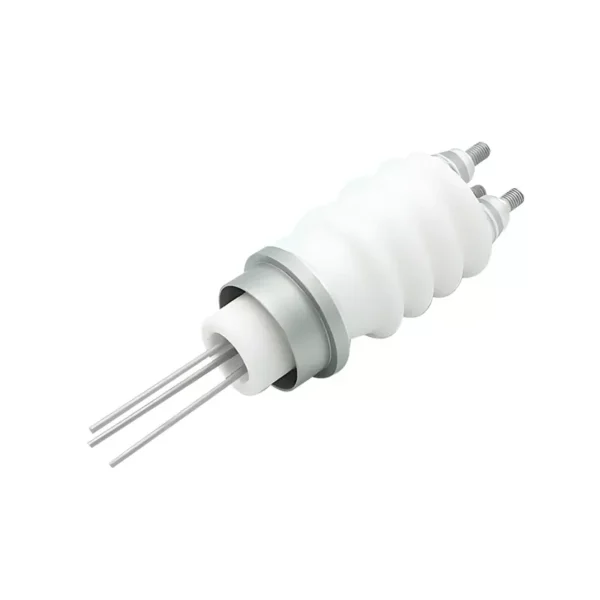
A high-voltage feedthrough is an interface assembly, not simply a ceramic body with a conductor. The buyer should define how power or signal passes through a wall, chamber, housing, or shield, and how the assembly is mounted and sealed. Explain conductor count, electrical separation, exposed ends, grounding features, nearby materials, and the direction of installation.
Include a section view showing ceramic, conductors, seals, sleeves, collars, terminals, and any joining features. Identify which elements are supplied as part of the requested component and which remain with the buyer’s equipment. This prevents quotations from appearing comparable while covering different assembly boundaries, termination assumptions, or installation responsibilities.
Set the electrical design basis
The RFQ should state the required electrical duty in terms appropriate to the application, including operating conditions, switching or transient exposure, insulation coordination, and any test method the buyer already uses. Avoid relying on a broad label such as high voltage. Suppliers need to understand whether the feedthrough carries continuous power, intermittent pulses, measurement signals, or mixed circuits.
Also define clearance, creepage, conductor spacing, shielding, polarity, and connection constraints where they affect the design. If the surrounding medium changes, such as air, vacuum, gas, oil, or process atmosphere, describe that condition and its pressure or contamination considerations without leaving critical values implicit. Ask suppliers to flag assumptions that require electrical engineering review.
Coordinate sealing and materials
A feedthrough can face mechanical, thermal, chemical, and pressure-related demands at the same interface. State the wall material, mounting method, seal location, joining process, service atmosphere, cleaning route, and expected cycling. If elastomers, brazes, glasses, metals, or plated regions are involved, identify compatibility concerns and request the proposed material combination for review.
Thermal expansion deserves explicit attention because ceramic, conductor, housing, and seal materials may respond differently during assembly or operation. Ask for the supplier’s joining concept, stress-control features, and any limitations on ramp rate or installation torque. The buyer should compare the complete interface design, not judge suitability from the ceramic material name alone.
Plan verification and inspection
Inspection requirements should connect directly to safety and installation. Depending on the assembly, request dimensional inspection of mounting features, conductor location, terminal orientation, ceramic condition, sealing surfaces, and critical interfaces. Define whether electrical proof, insulation, leakage, continuity, helium or other leak checks, visual examination, or documentation review is required, and state who supplies the acceptance method.
Feedthrough testing must be interpreted in relation to the assembled design and intended environment. Ask suppliers to identify test configuration, conditioning, sample basis, instrument limitations, and handling controls. If the item will enter a controlled chamber or clean process, include packaging, cleanliness, particle control, and traceability requirements in the same RFQ package.
Ask for a comparable quotation
A decision-ready inquiry includes the assembly drawing, mounting envelope, electrical schematic, environment, quantity assumptions, prototype status, inspection plan, and required records. Ask for confirmation of manufacturability, proposed ceramic and conductor materials, joining route, seal concept, test scope, packaging, and quotation exclusions. Request a marked-up drawing when interpretation is necessary.
Comparison should consider technical completeness as well as price. Ask each supplier to separate tooling, engineering review, testing, secondary operations, and documentation assumptions. Confirm how design changes, nonconformances, replacement units, and revision control will be handled. This creates a clear basis for selecting a feedthrough concept that fits the equipment and the buyer’s verification process.
Questions Before You Inquire
What information is essential for a high-voltage feedthrough RFQ?
Include a sectioned assembly drawing, electrical schematic, conductor details, mounting envelope, operating environment, sealing conditions, quantities, inspection plan, and required documentation. State the test methods or acceptance standards already used by the equipment owner. Any unclear boundary between ceramic, conductor, seal, and housing should be marked for review.
Does a ceramic feedthrough include the conductor and seals?
Not necessarily. Suppliers may quote a ceramic insulator, a joined subassembly, or a complete feedthrough with conductors, seals, terminals, and mounting hardware. Define the supply boundary in the drawing and request an itemised description so different quotations can be compared on equivalent scope.
Why must the surrounding environment be specified?
Electrical behaviour, sealing, contamination risk, thermal stress, and material compatibility can change with vacuum, gas, liquid, pressure, temperature cycling, or process chemicals. A generic high-voltage label is insufficient. Describe the real environment and ask suppliers to identify assumptions affecting insulation, joining, and leak performance.
What testing should buyers discuss with suppliers?
Discuss dimensional inspection, visual ceramic examination, continuity, insulation or proof testing, leakage checks, and any application-specific verification. The exact scope depends on the assembly and environment. Request the test configuration, sample basis, acceptance criteria, and report format rather than accepting an unexplained pass statement.
Send a Clear Component Brief
Share your drawing, quantity and application with Porcecore. Mark the requirements that are fixed and the questions that remain open.




Reviews
There are no reviews yet.