


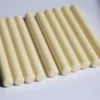
Porcecore can review a silicon nitride triangular block requirement as a shaped ceramic component rather than an off-the-shelf promise. Provide the section profile, face relationships, mounting conditions and service environment so suppliers can assess manufacturability, edge protection and application validation needs.
Key Inquiry Requirements
Why the triangular form matters
A triangular silicon nitride block is defined as much by its face relationships as by its material family. Angled faces may create a locating wedge, a support point, a flow boundary, a thermal interface or a compact structural insert. The RFQ should state which faces are functional, how the block is oriented and whether the triangle is symmetric, intentionally offset or part of a larger repeated pattern.
Avoid describing the component only as a small ceramic block. Explain what the geometry must accomplish in the assembly and which neighbouring parts establish its position. If the block is inserted into a channel, clamped between plates or used as a standalone support, show the contact boundaries. This allows the supplier to evaluate edge loads and propose suitable datum and finishing strategies.
Profile, datums and edge treatment
The drawing should define the triangular profile with a clear datum scheme. Identify side lengths, angles, apex position, thickness, corner transitions and any reliefs or holes. If the part is prismatic, specify the relationship between the end faces and the profile; if it tapers or changes section, include a section view. State which dimensions control assembly and which are allowed to follow the manufacturing process.
Apexes and sharp transitions require deliberate treatment because they can be vulnerable during forming, machining, inspection and installation. Indicate whether edges must remain sharp, receive a defined break or use a controlled radius. If contact occurs near a vertex, include the mating-part geometry and permissible contact band. A supplier should not have to infer whether a visible edge is functional or simply a drawing convention.
Material and loading considerations
Silicon nitride may be selected for shaped ceramic components where a combination of hardness, wear resistance, thermal stability or mechanical strength is relevant, but the actual requirement depends on the application. Describe the load direction, contact pressure, impact risk, sliding motion and any abrasive or corrosive media. These conditions determine which material and process questions must be answered before release.
State whether the block is loaded continuously, cycled, assembled and removed, or exposed to vibration. Explain whether it contacts metal, another ceramic, a coating or a compliant layer. If differential movement is expected, include the restraint arrangement rather than assuming that a close fit is always desirable. Application calculations or prototype trials may be appropriate where the block carries a consequential load.
Thermal and environmental definition
If the triangular block sits near a heat source, show the thermal path through its faces and identify any required isolation or transfer function. Describe heating and cooling sequence, local gradients, surrounding atmosphere and contact with process media. Avoid using a general material reputation as a substitute for a component-level review; the shape, finish, support and interfaces can all influence behaviour.
Environmental details should include particles, vapour, chemical contact, pressure condition and cleaning practice where relevant. Also identify whether the block is exposed to direct flame, radiant heat, electrical fields or reactive deposits. These factors guide material-grade discussion and inspection planning. If the service conditions are uncertain, say so openly and request a design review with validation recommendations.
Inspection and sourcing package
A practical acceptance plan should cover the triangular profile, angles, thickness, face flatness, relative orientation and edge condition. Identify the datum structure and measurement access, particularly if the block is small or has recessed features. Ask how the supplier will distinguish an acceptable edge break from a chipped corner, and how surface defects will be recorded on the inspection report.
Include the assembly section, current drawing revision, expected review quantities and any approved reference sample. Clarify whether the inquiry is for development pieces, a repeatable production route or a replacement part. Useful supplier responses include manufacturability comments, proposed process route, inspection method, packaging controls and open assumptions. These details make competing quotations technically comparable without implying stock or guaranteed performance.
Questions Before You Inquire
What makes a triangular ceramic block different from a rectangular block?
Its angled faces and vertices usually control location, contact and load transfer, so profile accuracy can matter as much as overall size. The RFQ should show the mating geometry, functional faces and edge requirements. A rectangular substitution may fit a nominal envelope while changing stress, alignment or process behaviour.
Which dimensions should be treated as critical?
Prioritize dimensions that establish seating, orientation, clearance and load transfer: profile angles, face relationships, thickness, locating features and functional edge positions. Mark them on the drawing with clear datums. Other dimensions can remain informational or process-controlled if they do not affect assembly or service.
How should the apex be specified?
State whether the apex must remain sharp, use a controlled radius or receive a defined edge break. Include the mating-part contact area and any limit on chipping. If the apex is not functional, a controlled protective treatment may improve handling. The correct choice depends on the load and installation method.
Can silicon nitride selection be made from hardness alone?
No. The block should be assessed against the full service condition, including loading direction, wear mode, thermal cycling, chemical exposure, mating materials and edge sensitivity. Request material and process information relevant to the proposed geometry, then use component testing or analysis where the application consequence warrants it.
Send a Clear Component Brief
Share your drawing, quantity and application with Porcecore. Mark the requirements that are fixed and the questions that remain open.

Reviews
There are no reviews yet.