


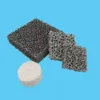

Describe the disc’s fluid, gas or particle-handling role and how it is retained in the assembly. Ask suppliers to distinguish material, pore structure, geometry and test methods, since these variables should be agreed rather than inferred from a product name.
Key Inquiry Requirements
Define the disc within its flow path
Start by showing how the disc sits in the equipment: supported across a face, captured in a holder, bonded around an edge or used as a replaceable filter element. Indicate the flow direction, active area, non-active rim and sealing surfaces. A section view is especially useful when the disc has a recess, stepped edge, backing support or asymmetric mounting.
Explain what the disc is expected to do in the process without turning that explanation into an unsupported performance guarantee. Identify whether the design concerns filtration, gas distribution, venting, separation or another controlled passage function. Include the medium, pressure relationships, cleaning approach and exposure conditions so the supplier can review the material and pore architecture together.
Translate porous structure into requirements
Porosity should be specified through the property or test method that matters to the application, not through a vague request for a porous ceramic. State the required relationship between flow, retention, pressure response or permeability where known, and identify which values are design targets versus acceptance limits. Ask the supplier to explain how the proposed material and process establish those characteristics.
Pore-related requirements must be considered alongside disc thickness, active area, support condition and edge sealing. A disc mounted differently may not behave like a freely exposed sample. Describe the holder, gasket, adhesive or retaining method, and ask whether the proposed geometry requires a support screen, protective rim or controlled compression during use and testing.
Control faces, edges and contamination
Call out both faces separately when they have different roles. Specify whether one face contacts a feed stream, a clean side, a support or a sealing element. Include thickness variation, flatness, edge profile and allowable chips where these influence seating or flow distribution. If the disc is heat resistant in service, also identify thermal cycling and atmosphere for material review.
Cleanliness can be as important as geometry for a porous component because open structure may retain loose material or process residue. Describe cleaning, packaging and handling expectations in practical terms. Ask the supplier to explain how particles, blocked pores, cracks and edge damage are screened, and which observations are measured, documented or treated as rejection conditions.
Establish meaningful inspection
Inspection should connect structure to the way the disc is used. Request dimensional verification for diameter, thickness, flatness and mounting features, together with an agreed method for porosity-related characteristics. If flow or filtration testing is required, define the test fluid, fixture concept, conditioning and reporting basis at a level that makes supplier results comparable.
Ask for sample or lot evidence only when it supports a stated decision. Compare whether each supplier can identify active area, seal area, support effects and test uncertainty. For development work, request a proposed characterization plan rather than presenting an unverified result as a guaranteed production property.
Build a porous disc RFQ
A complete inquiry includes the drawing, material family, process description, media information, flow direction, mounting section and quantity scenario. State whether the disc is a prototype, a replacement geometry, a filtration study or a production component. Include cleaning, storage and packaging constraints where contamination or blocked pores could affect evaluation.
Ask respondents to list material assumptions, pore-related test methods, dimensional controls, inspection records, handling precautions and design questions. Request alternatives only when they can be compared against the same functional criteria. Avoid relying on a photograph or a generic filter label; the RFQ should make the active region, sealing interface and acceptance logic explicit.
Questions Before You Inquire
What makes a porous ceramic disc RFQ different from a solid disc RFQ?
It must address the porous structure and the process role in addition to diameter, thickness and mounting. Define the medium, flow direction, active area, retention or permeability objective, support and cleaning method. Ask for the relevant test approach so suppliers are compared using meaningful evidence rather than labels alone.
Should porosity be stated as one number?
Only if the application and agreed test method make that number meaningful. Porous behavior can depend on structure, thickness, support, fluid and conditioning. Describe the required functional relationship or acceptance test, then ask the supplier to recommend a suitable material and characterization method for the intended assembly.
How should the disc sealing edge be shown?
Show the sealing land, holder, gasket or bonding region in a section view and identify the active area separately. State flatness, edge condition and cleanliness needs where they affect sealing or flow. If compression or adhesive is used, include the assembly sequence so the supplier can review the complete interface.
Can a supplier quote from a photograph of an existing filter disc?
A photograph can support an initial discussion but should not replace a controlled drawing and application description. Provide dimensions, mounting details, flow direction, media, cleaning conditions and known acceptance tests. If the existing disc is being analyzed, label observed features separately from confirmed design requirements.
Send a Clear Component Brief
Share your drawing, quantity and application with Porcecore. Mark the requirements that are fixed and the questions that remain open.


Reviews
There are no reviews yet.