


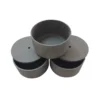

This page helps buyers specify a silicon carbide crucible without turning a material and form label into an unsupported performance promise. Define the process, vessel geometry, loading method and inspection expectations around the actual application.
Key Inquiry Requirements
Define the process vessel’s role
Describe what the crucible contains, transfers or exposes during processing. Identify the charge form, loading method, unloading method and whether the vessel is handled manually, mechanically or within a fixture. Include the furnace zone, support arrangement and nearby components. This gives the supplier the context needed to interpret vessel geometry and handling risks.
Explain whether the crucible is intended for melting, heating, reaction, transfer or another process step. State the process sequence and any changes between loaded, heated, held and cooled conditions. Do not infer operating limits from the material name. Instead, provide the known environment and ask for a design review that identifies missing conditions.
Control geometry and support
A crucible drawing should show the internal working volume, external envelope, wall transitions, base, rim, lid relationship and any pouring or handling features. Use datums tied to the support fixture and identify surfaces that must remain clear for loading or removal. If the shape is still under development, separate required interfaces from adjustable process-volume features.
Support conditions can strongly influence vessel behavior. Show contact points, bearing areas, restraints, clearance gaps and lifting tools. Include the load path for the empty and charged vessel where known. Ask the supplier to review local stress concentrations, wall transitions and handling features rather than evaluating only the nominal dimensions.
Connect silicon carbide to the atmosphere
Describe the process atmosphere and its changes during the cycle, including exposure to gases, vapors, residues or reactive materials. Identify contact with the charge and any cleaning or conditioning steps. Material selection should be reviewed against the complete process system, not treated as proof of a particular service outcome.
If the process has contamination controls, define them in practical terms. State which surfaces are critical, how cleanliness will be assessed and what packaging or pre-use handling is required. When thermal cycling or chemical exposure is central to the application, request a proposed evaluation plan and identify which observations will determine acceptance.
Inspect vessel condition and fit
Inspection should address working surfaces, rim and lid interfaces, base support, wall continuity, dimensional relationships and visible defects that could affect handling or process containment. Define the reference points and measurement method for the features that control furnace fit. If the vessel is large or difficult to measure, request a practical inspection plan before quoting.
Compare quotations by reviewing the proposed forming and finishing approach, process assumptions, inspection records and sample objectives. A process description may help explain expected variation, but it should not replace a controlled acceptance standard. Ask suppliers to identify areas where shape, surface condition or handling marks require application-specific agreement.
Prepare a reusable crucible RFQ
Include the latest vessel drawing, furnace and fixture views, process sequence, charge description, atmosphere summary, handling method and revision history. State whether the request is for a feasibility study, trial vessel, replacement design or recurring supply discussion. Provide enough context for the supplier to question unsuitable assumptions while keeping the drawing as the governing geometry document.
Request clear responses on material proposal, forming route, finishing operations, inspection scope, packaging, sample handling and change control. Identify all unknowns rather than filling them with generic values. This creates a traceable basis for comparing crucible proposals and allows process results to inform later geometry revisions without confusion.
Questions Before You Inquire
What information is essential for a silicon carbide crucible RFQ?
Provide the internal and external geometry, furnace envelope, support arrangement, charge description, loading method, atmosphere, process sequence and handling tools. Include the drawing revision and identify critical surfaces. If the process is still being developed, mark targets and open questions so the supplier can review feasibility without treating provisional values as final requirements.
Should crucible capacity be specified as a single number?
Capacity should be related to the actual charge, working volume, free space, loading method and furnace clearance. A single nominal volume may hide important shape constraints. Show the internal profile and required operating fill condition, then ask the supplier to confirm how the proposed geometry supports loading, heating, handling and removal.
What defects should be reviewed on a sample crucible?
Review dimensions, support fit, rim and lid interfaces, working-surface condition, wall continuity, base condition and visible chips, cracks or contamination. Acceptance criteria should reflect containment, handling and process risks. Record the inspection method and drawing revision so sample findings can be compared consistently across suppliers and later production discussions.
Can a silicon carbide crucible be selected from material name alone?
No. The crucible must be matched to its charge, atmosphere, thermal cycle, support arrangement, handling method and contamination requirements. Material family is only one part of the specification. A controlled drawing and process description allow the supplier to propose a suitable design and identify evidence needed before approval.
Send a Clear Component Brief
Share your drawing, quantity and application with Porcecore. Mark the requirements that are fixed and the questions that remain open.




Reviews
There are no reviews yet.