


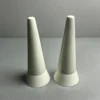
Porcecore can review a boron nitride dome component from a controlled drawing, model and service description. The RFQ should define the dome profile, wall strategy, mounting interface, exposed environment and functional role, then specify what must be inspected. The component form alone does not establish a standard size, material grade or guaranteed high-temperature result.
Key Inquiry Requirements
Define the dome’s functional shape
A boron nitride dome may be used as a cover, thermal barrier, insulator, protective shell or process-facing element. Explain which of these functions applies and identify the side exposed to the working environment. Provide the outer profile, inner profile, opening geometry, rim condition and orientation. If the curvature controls clearance or radiation space, show the mating assembly rather than only a standalone view.
A hemispherical appearance does not mean every surface has equal importance. Mark sealing, clamping, locating and clearance regions separately. Define whether the component is supported continuously or at discrete points, and show any slots, ports, flats or cutouts. These details allow a supplier to assess forming, machining, handling and inspection requirements without guessing the dome’s actual role.
Material and operating environment
Boron nitride is commonly considered where high-temperature resistance, electrical insulation or anti-adhesion behavior may be relevant, but those general associations cannot substitute for a documented application. State the intended atmosphere, process media, thermal cycling, pressure condition, electrical requirements and contact materials. Include whether deposits, release behavior or surface contamination are controlled concerns.
Ask for the proposed boron nitride grade and manufacturing route to be identified in the technical response. The choice between forming and finishing approaches can affect surface condition, geometry and inspection strategy. If the dome is exposed to reactive chemistry, vacuum, plasma, powder or repeated cleaning, include those conditions so the supplier can discuss material suitability and evidence requirements specifically.
Curvature, wall integrity and rim details
Dome components can be sensitive to wall variation, local thinning, unsupported rims and transitions around openings. Show section views and identify any region where the wall supports a load, maintains a gap or protects another component. Define the reference for curvature and the surfaces from which critical dimensions are measured. A clear model helps reveal interference that may be hidden in a two-dimensional outline.
Rim geometry deserves particular attention because it often controls installation and handling. Specify seating width, edge treatment, clamp clearance and any required flat or locating segment. If the dome must be removable, explain the extraction path and allowable contact points. The supplier should review whether the proposed features can be produced and inspected without introducing damage at fragile transitions.
Surface condition and inspection
For a dome, inspection should combine profile verification with visual and interface checks. Identify the datum scheme, critical opening dimensions, wall-related requirements, rim seating geometry and curvature references. If the inner surface faces a process, define expectations for residue, chips, particles, discoloration or handling marks. Use an agreed inspection method rather than assuming a photograph proves surface acceptability.
Consider whether the buyer needs a dimensional report, material documentation, marked inspection image or sample approval. The required evidence should follow the application risk. If the dome is part of an insulation or thermal-protection assembly, record the features that control spacing and alignment. If it acts as a process-facing shell, prioritize the surfaces and conditions that affect cleaning and use.
Prepare a dome-component RFQ
Send the latest controlled drawing, neutral 3D model, assembly section and operating description. State whether the part is for concept evaluation, prototype testing, qualification or repeat manufacture. Include packaging and handling instructions if the curved shell has delicate edges or must arrive clean. Identify customer-supplied fixtures, mating rings, seals or fasteners that influence the interface review.
Request separate comments on material grade, forming route, machining or finishing assumptions, inspection method and open design questions. Ask the supplier to confirm how curvature, rim geometry and surface condition would be evaluated. Keep commercial details such as order quantity and timing subject to quotation. This gives buyers a technically comparable response without turning a general dome description into an inventory promise.
Questions Before You Inquire
What should be shown on a boron nitride dome drawing?
Show the outer and inner profiles, openings, wall-related sections, rim details, datums, mounting interfaces and clearance envelope. Identify process-facing surfaces and functional curvature references. An assembly section is especially useful when the dome controls spacing, insulation, protection or access around another component.
Is a boron nitride dome automatically suitable for high-temperature service?
No. High-temperature suitability depends on grade, atmosphere, thermal cycling, mechanical support, contamination and the actual operating conditions. Provide the service environment and request a material recommendation tied to the design. Do not treat a general material description or a product image as proof of guaranteed performance.
Can dome components include ports or cutouts?
They may, subject to curvature, wall integrity, edge condition, forming route and inspection access. Define each opening with sections, orientation and functional tolerances. Explain whether the cutout is for flow, wiring, viewing, mounting or clearance. The supplier should review local stress and handling risks before approval.
Are standard boron nitride hemispheres available?
This page supports custom, drawing-led sourcing rather than a standard-size or stocked-parts assumption. The grade, profile, wall condition, finish, inspection documents, order terms and timing must be confirmed for each design. The described dome should not be treated as a guaranteed Porcecore-made component.
Send a Clear Component Brief
Share your drawing, quantity and application with Porcecore. Mark the requirements that are fixed and the questions that remain open.


Reviews
There are no reviews yet.