

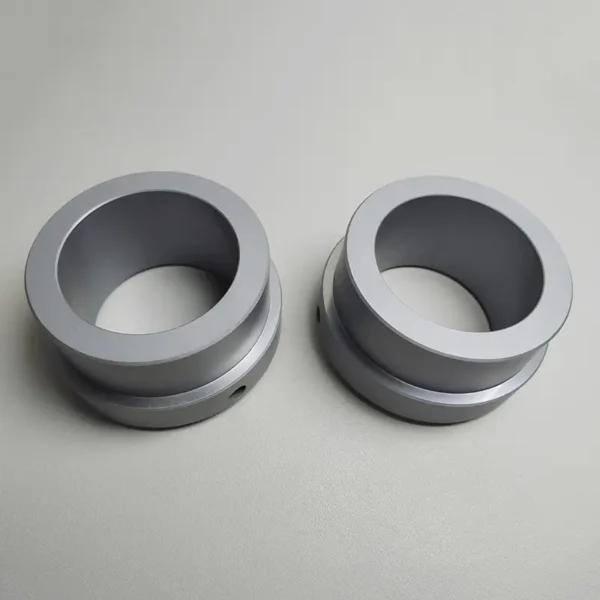

Specify the sleeve as part of a guided, protected or wear-facing assembly. The RFQ should connect the bore and outside diameter to mating hardware, movement, environment, mounting method, inspection evidence and handling requirements.
Key Inquiry Requirements
Clarify the sleeve function
A sleeve can guide a moving element, protect a substrate, create a wear-facing surface or isolate two components. State the intended function and identify the parts contacting the bore, outside diameter and ends. This context determines which surfaces are functional and whether the sleeve is free, retained, bonded, clamped or installed with an interference condition.
Provide an assembly sketch with shaft, housing, support points and movement direction. Note whether rotation, reciprocation, vibration, impact or contamination is expected. A sleeve’s suitability cannot be judged from its tubular outline alone because support length, load path and alignment strongly influence how the ceramic is used.
Silicon carbide material definition
Silicon carbide is a technical ceramic family with possible differences in grade, microstructure, processing route and finishability. Request the proposed material designation and applicable controls rather than accepting an unspecified silicon carbide label. The RFQ should explain whether the priority is wear resistance, chemical exposure, thermal environment, electrical behaviour, dimensional stability or a combination of these factors.
Describe the process atmosphere, fluid contact, cleaning method and nearby materials when they may affect the sleeve. If the component sees high heat or a temperature gradient, provide the operating sequence and support condition. Suppliers should discuss the proposed grade against those facts without turning generic material reputation into an unsupported guarantee.
Bore, wall and mounting geometry
The bore is often the primary functional surface, but the outside diameter and end faces may control support and alignment. Define bore size, outside diameter, wall thickness, length, concentricity, straightness, end squareness, chamfers and radii according to the assembly need. Use datums and identify surfaces that require special finish or protection.
Explain how the sleeve is installed and retained. Press fits, adhesives, clamps, shrink methods and floating arrangements create different design questions. Include mating dimensions and assembly conditions where available, and ask suppliers to flag thin-wall, slotting, drilling or edge-risk concerns before the geometry is treated as production-ready.
Wear and dimensional inspection
Inspection should focus on the dimensions that control guidance, clearance, alignment and retention. Define measurement locations along the bore and outside diameter if taper, out-of-roundness or local variation matters. State how end damage, chips, cracks, grinding marks and surface contamination are assessed, especially when the sleeve enters a close-fitting assembly.
If wear is a design concern, specify the starting geometry and the method by which wear or surface change will be evaluated. Avoid asking for a vague wear-life guarantee. Instead, provide the duty cycle, counterface material, motion, contact conditions and inspection interval needed for an engineering review of the selected sleeve.
Build a complete sleeve RFQ
The enquiry should contain the current drawing, assembly section, mating-part details, operating environment, quantity basis, prototype or production intent, inspection requirements and packaging expectations. Identify whether the sleeve must be individually protected, kept clean, or delivered with orientation or lot labels. Include any restrictions on machining, coating, joining or post-processing.
Ask bidders to list the silicon carbide grade, manufacturing route where relevant, assumptions, inspection records, deviations and proposed handling method. Compare the offers against the same functional surfaces and acceptance criteria. Confirm final tolerances and interfaces through engineering review before placing an order, particularly where the sleeve is thin-walled or difficult to replace.
Questions Before You Inquire
What is the most important dimension on a silicon carbide sleeve?
Usually the bore is central to guidance or clearance, but the outside diameter, wall thickness, length, concentricity and end geometry may be equally important for support. The correct priority depends on the assembly. Provide mating-part dimensions and mark functional surfaces so the supplier can quote the intended interface.
How should a sleeve’s mounting method be described?
State whether the sleeve is free, clamped, bonded, press-fitted, shrink-installed or otherwise retained. Include mating materials, assembly conditions and any service movement. These details affect clearance, stress and manufacturability. If the method is undecided, ask suppliers to identify feasible options and their assumptions.
Does silicon carbide automatically guarantee wear resistance?
No. Material family reputation does not replace application review. Wear depends on counterface material, load, motion, contamination, lubrication or atmosphere, surface condition and alignment. Provide those conditions in the RFQ and request a proposed grade and evaluation basis rather than an unsupported service-life promise.
What inspection evidence should accompany the quotation?
Ask for the proposed dimensional inspection plan, visual acceptance criteria, material identification and reporting format. Specify which characteristics are checked per piece or by sample. If the sleeve has a critical bore or thin wall, request measurement locations and datums that correspond directly to the drawing and incoming inspection method.
Send a Clear Component Brief
Share your drawing, quantity and application with Porcecore. Mark the requirements that are fixed and the questions that remain open.

Reviews
There are no reviews yet.