

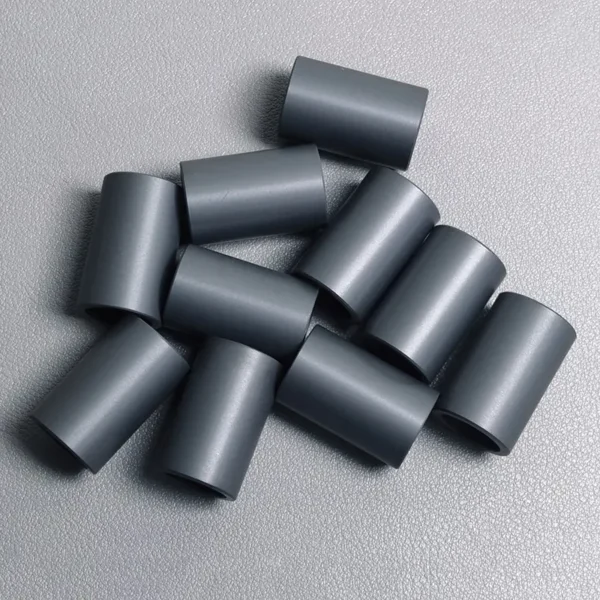


Define the bore, outside geometry, length, ends, supports and process exposure together. A complete tube RFQ lets suppliers evaluate ceramic design, finishing, assembly risks and inspection requirements against the intended service.
Key Inquiry Requirements
Define the tube’s service role
A silicon carbide tube may function as a process passage, protective sleeve, wear-resistant liner, support or barrier around another component. Explain what moves through or around it, whether the tube is internally or externally exposed, and how it is retained. The same nominal tube form can require very different geometry and inspection priorities depending on pressure, flow, abrasion or contact conditions.
Silicon carbide is commonly considered for combinations of high-temperature capability, strength, wear resistance, corrosion resistance and thermal conductivity. These are material-selection considerations, not unconditional service promises. Describe the actual temperature changes, chemistry, solids loading, contact points and cleaning practice so suitability can be reviewed in context.
Specify bore and wall geometry
Provide the bore profile, outside profile, overall length and wall definition from functional datums. Identify straight sections, tapers, steps, slots, ports, closed ends, grooves and any transitions. If flow or clearance matters, state which internal dimensions are critical and how they relate to the tube axis. Include concentricity or runout requirements only where the assembly needs them.
Ends often determine whether a ceramic tube can be installed safely and aligned correctly. Define chamfers, radii, shoulders, sealing lands, threads or other termination details on the drawing. Explain whether the ends are exposed, captured, joined or supported, and identify any area where edge chips could interfere with assembly.
Review mounting and thermal conditions
Ceramic tubes are sensitive to how they are supported and constrained. Show supports, retainers, sleeves, seals and adjacent materials in an assembly section. Explain whether the tube is free to expand, clamped at one end, surrounded by a liner or exposed to differential movement. These details help the supplier review stress concentrations and clearance assumptions before quotation.
Describe heating and cooling conditions, process chemistry, abrasion source and cleaning method. If the tube transfers heat, identify the intended path and contact arrangement. Avoid specifying a broad maximum or guaranteed lifetime without supporting design evidence; instead, ask for a technical review based on the actual service envelope and proposed geometry.
Inspection for tubular components
Inspection may need to cover bore size and continuity, outside dimensions, wall thickness, length, straightness, concentricity, end geometry and visible surface condition. Mark restricted zones and inspection access on the drawing. If the bore cannot be measured conventionally, define an alternative method or acceptance evidence before requesting quotations.
Compare suppliers using the same inspection scope and reporting expectations. Ask how internal defects, blocked passages, edge damage and handling marks will be evaluated, while recognizing that acceptance methods depend on geometry and process. Include traceability, identification and packaging requirements where tubes could be damaged or mixed during transport and installation.
Build a clear tube RFQ
Send the tube drawing, assembly layout, process description, quantity range, application cycle and inspection requirements. Identify whether the request covers a complete tube, a liner section or a tube with attached hardware. State the preferred material family while allowing the supplier to flag grade, forming or finishing questions that affect manufacturability.
Request a quotation that identifies tooling, machining, inspection and packaging assumptions. Ask for proposed clarifications on wall thickness, ends, support clearances and critical surfaces. Keep any reference photograph subordinate to the controlled drawing, and do not infer stock availability, minimum order quantity, price or delivery commitment from the pictured component.
Questions Before You Inquire
What should a silicon carbide tube drawing show?
Show bore and outside geometry, wall definition, length, ends, transitions, ports, datums and critical alignment requirements. Add an assembly section with supports, retainers, seals and adjacent materials. Explain the process exposure and inspection method, especially where internal features or hidden surfaces affect function.
Which applications may consider silicon carbide tubes?
Applications may consider silicon carbide where combinations of high-temperature capability, strength, wear resistance, corrosion resistance or thermal conductivity are relevant. The appropriate design depends on the actual process, mounting and thermal cycle. Treat these characteristics as evaluation criteria, then request a supplier review against the complete service envelope.
How should tube wall thickness be specified?
Define the wall from the bore and outside geometry, then identify whether minimum thickness, uniformity or local transitions are critical. Include support and load conditions because a nominal wall value alone may not describe the structural requirement. Ask the supplier to flag geometry that could be difficult to form, machine or inspect.
Can a silicon carbide tube be used as a liner?
It may be considered as a liner when the bore, chemistry, abrasion and mounting arrangement are suitable. The liner must be reviewed with its host component, including clearances, expansion, joining and replacement access. Provide the host geometry and retention method instead of assuming that any tube can be installed interchangeably.
Send a Clear Component Brief
Share your drawing, quantity and application with Porcecore. Mark the requirements that are fixed and the questions that remain open.


Reviews
There are no reviews yet.