

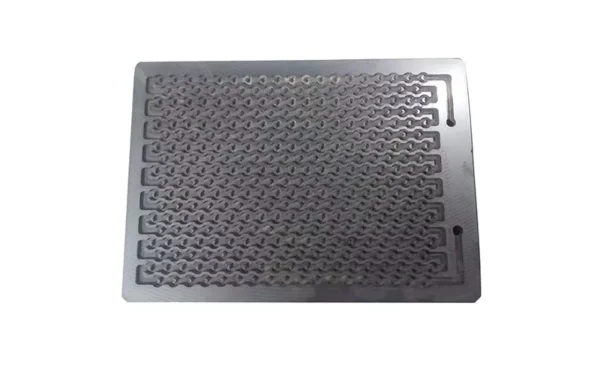

Provide the microreaction plate drawing, fluidic scheme, process chemistry and joining concept so suppliers can assess the complete channelled assembly rather than quote an isolated ceramic shape.
Key Inquiry Requirements
Translate the process into plate geometry
Define the plate through the process path, not only its outside outline. Show channels, grooves, cavities, manifolds, ports, dead legs, mixing features, sealing lands and reference datums. Identify channel surfaces that control flow or residence behavior, along with regions reserved for heaters, sensors or supports. If a layered assembly is planned, provide an exploded view showing how each plate aligns and functions.
State which dimensions are critical to the reaction or flow and which are packaging features. Include port standards or custom interfaces, access direction, connection clearances and cleaning route. Explain whether the part is used alone, stacked, bonded, clamped or joined with a cover. This context helps suppliers review thin webs, internal corners, openings and edge conditions that may be difficult to inspect after assembly.
Define material and process compatibility
Silicon carbide is often considered for chemically demanding or thermally intensive environments, but material selection still depends on the actual process. Identify fluids, gases, solids, concentrations, contaminants, pressure conditions, temperature cycling, atmosphere and cleaning agents. Ask suppliers to state the proposed material grade, surface condition and available compatibility evidence rather than treating the family name as proof of suitability.
Describe whether the reaction plate needs a bare ceramic surface, a coating, a liner, a bonded cover or integrated metal hardware. Specify acceptable residue, outgassing or contamination limits where they affect the process. If catalyst, reagent or product contact occurs, identify the wetted surfaces and any qualification requirements. The quotation should distinguish base fabrication from secondary treatment, joining, cleaning and verification.
Control channels, seals and interfaces
Microreaction performance can depend on channel continuity, surface condition and alignment between layers. Mark sealing lands, gasket grooves, bond lines, manifold transitions and port faces with clear datums. Define flatness, parallelism, surface finish and edge requirements where they influence leakage or flow distribution. Note whether the assembly allows rework or must be permanently joined after inspection.
Provide the seal material, compression concept, joining temperature and allowable deformation if those are already established. If not, label them as development inputs and request a feasibility review. Explain how the plate will be restrained during operation and how thermal expansion is accommodated. Suppliers can then identify risks around thin walls, sharp transitions, blocked passages, incomplete joining or inaccessible inspection areas.
Plan inspection and functional validation
Dimensional inspection alone may not prove a microreaction plate is usable. Match inspection to the architecture: verify external features, ports, channel openings, sealing surfaces and alignment datums, then define how internal passages will be checked where accessible. Depending on the design, useful methods may include visual examination, flow comparison, leak testing, pressure testing, cleaning verification or imaging. State which methods are required and what records must accompany approval.
Validation should use representative fluid properties, flow conditions, pressure, thermal profile and assembly restraint. Define acceptance around leakage, blockage, connection integrity, channel continuity and repeatability of the approved configuration. Avoid asking for an unexplained performance guarantee. Instead, provide a test plan or request a proposed plan with assumptions clearly identified. Sample plates and assembled coupons may be appropriate before committing to a full production design.
Assemble a complete microreaction plate RFQ
Include the revision-controlled drawing, channel or fluidic schematic, 3D model, layer stack-up, process conditions, wetted materials, joining method, seal concept, quantity assumptions and sample requirements. Add installation photographs when ports or service access are difficult to interpret. State whether the plate is for laboratory development, pilot equipment or a repeatable production assembly, because documentation and validation expectations may differ.
Ask for a marked-up design review covering manufacturability, inspection access, cleaning, packaging and change control. Separate requirements for the ceramic plate, cover, joining operation and final assembly. Clarify how open channels will be protected during shipment and how incoming inspection will detect damage or contamination. A precise RFQ creates a defensible basis for comparing process risk, evidence and total scope.
Questions Before You Inquire
What information should be supplied for a silicon carbide microreaction plate RFQ?
Provide channel drawings, ports, manifolds, sealing lands, layer stack-up, datums and critical dimensions, plus process fluids, pressure, temperature, atmosphere and cleaning conditions. Include the joining method, cover design, sample plan, inspection records and functional tests. A fluidic schematic and assembly photograph can resolve ambiguities that a flat drawing leaves open.
How can internal channels be inspected?
The method depends on channel access, geometry and the required evidence. Possible approaches include dimensional checks at openings, visual inspection, flow comparison, leak or pressure testing, cleaning verification and suitable imaging. Define the critical passages and acceptance method in the RFQ, then ask the supplier to confirm feasibility and documentation.
Does silicon carbide automatically suit every reactive process?
No. Compatibility depends on the specific silicon carbide grade, surface condition, process chemistry, concentration, temperature, pressure, atmosphere and cleaning method. Identify every wetted surface and request evidence relevant to the intended process. If product purity or contamination is important, define the requirement and validation route explicitly rather than relying on the material name.
Should the plate be quoted alone or as an assembly?
Quote structure should follow the design. If the plate is bonded, clamped, sealed or joined to a cover, request separate scope for the ceramic, cover, seals, joining and final inspection. This exposes interface assumptions and makes comparison easier. A plate-only quotation may omit risks that arise during assembly or functional testing.
Send a Clear Component Brief
Share your drawing, quantity and application with Porcecore. Mark the requirements that are fixed and the questions that remain open.



Reviews
There are no reviews yet.