
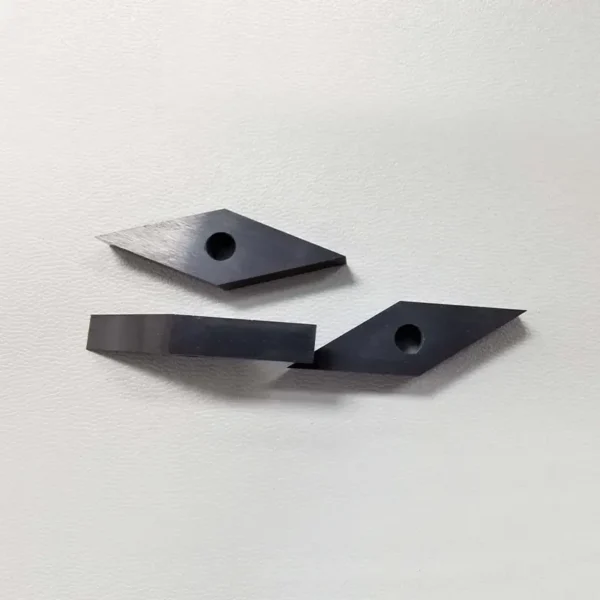



The diamond or rhombic outline is only the beginning of the specification. Provide the block arrangement, mating geometry, orientation, retention method and expected mechanical environment. Compare candidates by corner definition, edge condition, dimensional control, surface finish, material documentation and packaging. If the blocks contact moving, abrasive or impact-prone parts, describe those conditions rather than relying on a broad wear-resistance assumption.
Key Inquiry Requirements
Define what the diamond block does
A diamond-shaped ceramic block may serve as a contact insert, guide, wear surface, locator or another specialized element. State the actual function and show how the blocks are arranged in the assembly. Include orientation, pitch, neighboring parts, contact direction and the reason for the angled corners. This information determines which faces, edges and transitions need the strongest drawing controls.
Describe how loads reach the block and how the block is retained. Compression, sliding, impact, clamping, adhesive bonding and constrained insertion create different risks for a brittle ceramic. Include support length, backing material, clearance and removal method. A supplier cannot assess the geometry meaningfully if the block is quoted as an isolated rhombus without the force and retention context.
Review silicon nitride against the real contact environment
Silicon nitride is a technical ceramic family used in demanding mechanical designs, but the suitable grade and finished-part behavior depend on the application. Describe contact pressure, motion, impact, abrasion, particles, lubrication, moisture, chemicals and temperature exposure where relevant. Identify whether the block is continuously loaded, cycled or occasionally struck. These details allow material and process assumptions to be reviewed against the actual service environment.
Request the proposed material designation, forming route, machining approach and available documentation. If the application depends on strength, fracture resistance, wear behavior or friction, define the test method and acceptance basis rather than requesting an unqualified superior value. Keep reference data separate from a contractual finished-part requirement, especially when geometry, surface finish and edge treatment influence contact behavior.
Control the angled geometry and working edges
For diamond or rhombic blocks, the corner angles, bevels, edge radii and face relationships may control contact behavior more directly than the overall outline. Identify the primary datum face, orientation features and functional edges. Mark whether corners must remain sharp, receive a defined treatment or be protected from contact. The drawing should distinguish intentional edge geometry from permissible handling damage.
Show any holes, slots, flats, grooves or bonded surfaces that affect placement. If multiple blocks operate as a pattern, provide the pattern drawing and assembly tolerances rather than specifying each piece independently. Buyers should also identify whether blocks are matched, orientation-sensitive or interchangeable. These decisions change inspection, marking, packaging and the practical meaning of dimensional variation across a set.
Inspect the features that affect contact reliability
Inspection should cover overall geometry, angle or orientation, functional face condition, edge integrity, surface finish where relevant and any locating feature that controls the contact pattern. Define how chips, cracks, discoloration, machining marks and edge variation are evaluated. If the component works in a set, state whether inspection is individual, matched-set or assembly-based, and identify the records needed for traceability.
Packaging should prevent blocks from contacting one another during transport. Specify separators, orientation, moisture or contamination controls and labeling if the blocks are small or direction-sensitive. At receipt, inspect before unpacking the full set where practical and compare the pattern against the assembly drawing. Record any shipping damage separately so later chipping from installation is not attributed incorrectly to manufacture.
Build the quotation around the mating parts
The RFQ should include the block drawing, mating-part drawings, assembly orientation, load description, retention method, expected cycling and intended production stage. State whether the geometry is new, adapted from an existing part or being used as a replacement. Add photographs only to explain context, and identify any visible feature that is not yet a controlled requirement.
Ask suppliers to identify manufacturing assumptions, achievable inspection references, material documentation and risks associated with sharp or treated edges. Request a sample review plan if the contact pattern is sensitive to orientation or surface condition. This gives engineering and purchasing a common basis for evaluating proposed blocks without confusing a familiar diamond outline with a verified solution.
Questions Before You Inquire
What does the diamond shape define, and what does it not define?
It defines a general component form and may suggest an angled contact or wear geometry, but it does not define loading, orientation, edge treatment, retention, material grade or acceptance criteria. The RFQ should show the block in its assembly and control the functional faces, corners, pattern and mating interfaces.
Which silicon nitride information should be requested?
Request the proposed grade, forming and finishing route, relevant material documentation and any available traceability. Describe the actual contact environment and define required mechanical or wear properties with test methods and limits. Avoid accepting broad claims as specifications unless they are tied to the finished geometry and agreed inspection evidence.
How should edge damage be handled?
Define functional edges, intentional bevels or radii, and the method used to assess chips or cracks. Packaging should separate the blocks and protect corners. Incoming inspection should occur before assembly, with shipping damage recorded separately. If edge condition controls contact behavior, include representative acceptance images or measurable drawing criteria.
Do blocks in one assembly need to be matched?
That depends on the contact pattern and design intent. If position, orientation or height relationships matter, state whether blocks must be matched, identified or inspected as a set. If they are interchangeable, define the allowable variation and orientation rules. The assembly drawing should make this decision explicit before quotation.
Send a Clear Component Brief
Share your drawing, quantity and application with Porcecore. Mark the requirements that are fixed and the questions that remain open.


Reviews
There are no reviews yet.