



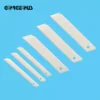
Define the blade geometry, edge intent, operating environment and inspection method before requesting a quotation. Porcecore can review your drawing and application requirements without treating the pictured form as an inventory promise.
Key Inquiry Requirements
Blade Geometry and Cutting Intent
A zirconia blade RFQ should identify the complete profile rather than relying on a product name or image. Include overall outline, thickness, edge location, mounting features, corner treatment, holes or slots, and any datum scheme used for inspection. State whether the blade is intended for straight cuts, interrupted cuts, trimming, or another operation so the supplier can interpret geometry in context.
Thin-film cutting places particular emphasis on edge definition and handling. Explain the material being cut, its supported condition, expected cut path, contact arrangement, and whether the blade is fixed or replaceable. These details help distinguish a simple flat profile from a component requiring controlled edge preparation, balanced mounting, or special attention to fragile regions during manufacture and inspection.
Material Definition and Comparisons
Although the requested material family is zirconia, the RFQ should still identify any preferred grade, stabilization system, color requirement, or approved alternatives. If those choices are open, ask suppliers to state the proposed material designation and the reasoning behind it. Avoid comparing blades only by nominal hardness or sharpness; the relevant comparison depends on edge design, workpiece interaction, fracture sensitivity, and cleaning conditions.
A useful technical comparison considers the complete blade system: ceramic body, edge treatment, holder, clamping method, and replacement practice. Ask whether the proposed design is suited to the stated cutting interface and how the supplier will control critical features. If a substitute ceramic is considered, require a documented deviation rather than allowing a material change to remain implicit.
Inspection and Edge Condition
Inspection requirements should describe how the drawing will be verified, including profile measurement, thickness checks, mounting-feature location, flatness or runout where relevant, and visual examination of the cutting edge. Define the acceptance method for chips, cracks, edge waviness, discoloration, and handling marks. If the edge is functionally critical, identify the measurement approach instead of using an undefined phrase such as razor sharp.
Request representative inspection records or a proposed control plan when the blade will enter a repeatable cutting process. The record should connect measured features to drawing datums and identify the inspection stage. Clarify whether edge inspection occurs before coating, assembly, or packaging, if those operations are part of the supplied configuration.
Mounting, Handling and Use Conditions
A blade can perform differently depending on how it is supported. Include holder details, clamping contact, exposed cutting length, alignment references, rotation or reciprocation, and any permitted adjustment. State the workpiece support and whether debris, fluid, vacuum, or dry handling forms part of the process. These inputs let the supplier review stress concentrations and identify questions that a two-dimensional outline cannot answer.
Packaging and handling deserve a place in the quotation discussion because ceramic edges may be vulnerable before installation. Define individual protection, orientation, traceability needs, and the point at which the buyer will inspect incoming parts. If the blade is replaced during maintenance, describe the changeover method and any features needed to preserve alignment between replacements.
RFQ Package and Supplier Review
Send a dimensioned drawing, revision level, quantity by release if known, application description, and inspection expectations. Include photographs only as orientation aids; the drawing and written requirements should control. Ask each supplier to identify assumptions, exclusions, proposed material designation, edge-processing approach, and any features requiring confirmation before quotation. This produces a more useful comparison than evaluating a nominal blade description alone.
Before approval, compare quotations against geometry, material disclosure, inspection evidence, packaging, and communication of technical risks. Confirm which characteristics are quoted as requirements and which are merely recommendations. A clear RFQ also records questions about service environment, cleaning, handling, and installation so later changes do not silently alter the component definition.
Questions Before You Inquire
What information should accompany a zirconia blade drawing?
Provide the blade outline, thickness, edge location, mounting features, datums, revision level, workpiece description, cutting motion, support condition, and inspection expectations. Photos can clarify orientation, but they should not replace controlled dimensions or written requirements for the cutting edge and mounting interface.
Should the RFQ specify a zirconia grade?
If a grade or stabilization system is required, state it directly. If selection is open, ask the supplier to identify the proposed designation and any alternatives. The decision should consider geometry, edge sensitivity, workpiece interaction, environment, and inspection—not a generic claim that one material is universally best.
How should blade sharpness be specified?
Avoid using sharpness as an undefined acceptance term. Describe the edge geometry, allowable edge condition, functional cutting test if applicable, and the measurement method. Include limits for chips, cracks, waviness, or other visible conditions, with drawing datums or inspection references where they affect use.
Does Porcecore offer zirconia blades from stock?
This page is intended for drawing-led RFQs, not a stock or availability statement. Submit the controlled geometry and application information for review. The quotation should identify assumptions, proposed material details, inspection scope, packaging expectations, and any open questions before the design is accepted.
Send a Clear Component Brief
Share your drawing, quantity and application with Porcecore. Mark the requirements that are fixed and the questions that remain open.


Reviews
There are no reviews yet.