

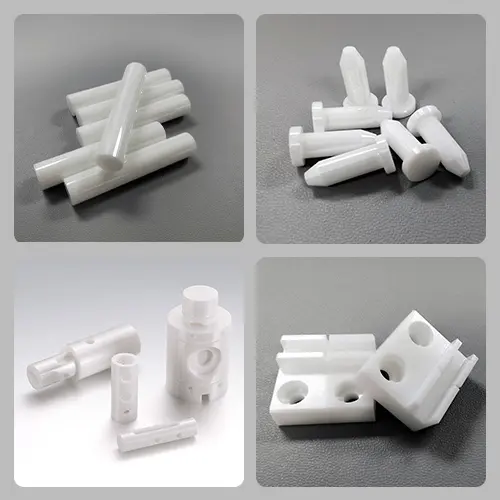


Use the RFQ to establish the pin’s geometry, interfaces, material grade, finish, inspection scope, and application environment before comparing manufacturing routes or quotations.
Key Inquiry Requirements
Define the pin’s working role
A zirconia ceramic pin may serve as a locating element, spacer, insulator, guide, wear interface, or mechanically retained insert. The same general form can require very different design controls depending on whether it enters a bore, carries contact load, separates conductive parts, or supports alignment. State the pin’s function, mating materials, assembly method, exposed surfaces, and any contact or motion involved.
Start with the controlled drawing rather than a catalogue description. Identify the nominal diameter, overall length, end geometry, shoulders, grooves, flats, holes, chamfers, and datum scheme that matter to assembly. If the pin is used in a repeated mechanism, describe insertion, removal, sliding, press fitting, adhesive bonding, or retention so suppliers can review the geometry against the intended installation method.
Compare zirconia options carefully
Zirconia is a material family rather than one universal specification. An RFQ should request the proposed grade, stabilisation system, forming route where relevant, and finishing approach, while keeping the decision tied to the application. Compare fracture sensitivity, surface condition, wear interaction, thermal cycling, chemical exposure, and electrical requirements against the actual duty instead of selecting on material name alone.
The drawing should distinguish functional surfaces from non-critical areas. A polished or closely controlled cylindrical surface may be necessary for a seal, guide, or sliding interface, while an uncontacted end may have different requirements. Ask suppliers to identify material substitutions, process assumptions, and any design features that could affect edge integrity, concentricity, straightness, or resistance to assembly damage.
Build a useful drawing package
Include units, datums, geometric controls, surface-finish callouts, edge treatment, and definitions for any partial dimensions. Show the relationship between the pin axis and features such as flats, cross holes, steps, or end faces. If the pin must mate with a metal, polymer, or ceramic component, supply the mating dimensions and assembly sequence so fit is evaluated as a system.
Application notes can be as important as the section view. Specify whether the part sees vacuum, moisture, chemicals, particles, repeated cycling, impact, or elevated temperature, without replacing measured requirements with broad labels. Where cleanliness matters, define the cleaning method, packaging expectation, prohibited residues, and inspection points that must be confirmed before shipment.
Inspect geometry and surface condition
Inspection should focus on the characteristics that control fit and service. Depending on the design, these may include diameter, length, roundness, straightness, perpendicularity, concentricity, feature location, edge condition, and visible damage. Tell the supplier which dimensions require recorded results, which may be sampled, and which characteristics need a defined measurement method rather than a visual statement.
Ceramic pins can be sensitive to chips, scratches, handling marks, and local defects at edges or contact zones. Define acceptance photographs, magnification, surface criteria, and packaging controls where appropriate. If a coating, metallised region, adhesive interface, or secondary operation is involved, request inspection of that operation separately and identify how traceability should connect it to the base component.
Make the RFQ decision-ready
A strong inquiry should include the latest drawing revision, annual or project quantity, prototype versus repeat-production status, target application, and required submission documents. Ask for confirmation of manufacturability, proposed material specification, process limitations, inspection capability, packaging method, and quotation assumptions. Separate mandatory requirements from preferences so responses can be compared without hidden interpretation.
Request clarification before accepting a nominally similar pin. Useful questions cover minimum feature capability, achievable finish, datum interpretation, sampling plan, nonconformance handling, and whether any geometry should be revised for reliable production. The objective is a documented technical comparison that lets the buyer select a suitable route, not an assumption that every zirconia rod is interchangeable.
Questions Before You Inquire
What should accompany an RFQ for a zirconia ceramic pin?
Provide the controlled drawing, application description, mating-part information, expected quantities, inspection requirements, packaging needs, and environmental conditions. Also identify critical surfaces and assembly method. If the design is still developing, request a manufacturability review and clearly mark all provisional dimensions or performance assumptions.
Can a standard zirconia rod replace a custom pin?
Only if the rod satisfies the complete functional drawing, including geometry, fit, edge condition, finish, and inspection requirements. A similar diameter or length does not establish interchangeability. Ask the supplier to identify deviations, secondary machining needs, and risks introduced by adapting a general rod.
Which defects deserve attention on ceramic pins?
Pay particular attention to chips, cracks, scratches, edge damage, out-of-round sections, bent axes, and feature mislocation. Their importance depends on the pin’s role and mating interface. Define acceptance criteria and measurement methods in advance so visual review and dimensional inspection support the same decision.
How should zirconia grade be handled in the inquiry?
Name the required material family and application constraints, then ask suppliers to state the proposed zirconia grade and relevant processing assumptions. Compare options against wear, fracture, thermal cycling, chemical exposure, and electrical needs. Do not accept an unspecified grade when material behavior affects the design.
Send a Clear Component Brief
Share your drawing, quantity and application with Porcecore. Mark the requirements that are fixed and the questions that remain open.


Reviews
There are no reviews yet.