

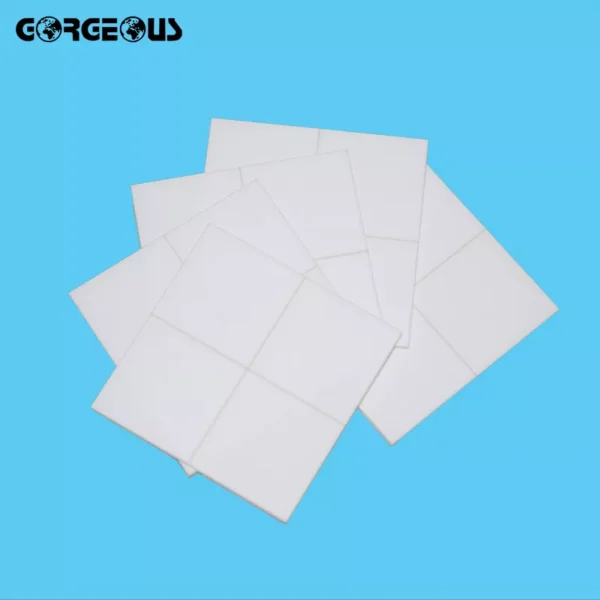

Use the RFQ to define substrate geometry, surface requirements, pattern interfaces, and the evidence needed for qualification.
Key Inquiry Requirements
Define the Substrate’s Role
A zirconia substrate may serve as a structural base, insulating carrier, wear-facing element, or platform for a deposited or attached layer. State the substrate’s role before selecting dimensions or finish requirements. Explain the adjacent materials, joining or coating sequence, handling method, and environmental exposure so the quotation addresses the complete interface rather than an isolated sheet.
Identify which faces are functional and whether the substrate is flat, stepped, perforated, patterned, or assembled into a larger module. Include openings, edge profiles, corner radii, orientation marks, and datum references on the drawing. If thin-film, printed, bonded, or metallized features are involved, provide their locations and process sequence as controlled design information.
Compare Surface and Thickness Requirements
Substrate comparisons should cover the material designation, surface condition, thickness definition, flatness approach, edge treatment, and compatibility with the next process. Ask suppliers to explain whether the quoted surface is as-processed, finished, or prepared for coating or bonding. This avoids comparing nominally similar substrates with different functional surfaces.
For a layered or patterned application, discuss how thickness variation, waviness, particles, scratches, and edge damage could affect downstream work. Define the measurement method, sampling plan, and inspection reference. If the drawing leaves a characteristic open, request a proposal with the assumption clearly stated rather than allowing an unrecorded interpretation to become part of the supply basis.
Address Patterned or Layered Interfaces
When a substrate carries a film, trace, coating, adhesive, or attached component, the RFQ should distinguish ceramic requirements from downstream process requirements. Show keep-out zones, alignment references, exposed areas, and any restrictions on cleaning or handling. Provide the layer stack or process notes where they influence substrate selection or inspection.
Ask the supplier to identify risks around edge chipping, warpage, contamination, handling marks, and feature registration. If the supplier is only quoting the ceramic substrate, state that boundary explicitly. If additional processing is requested, define which steps are included and which require a separate engineering review or customer-approved process window.
Build the Inspection Plan
A substrate inspection plan should connect each acceptance criterion to a measurement method. Specify dimensions, thickness locations, flatness or parallelism references where relevant, surface condition, edge quality, holes, patterns, and cleanliness expectations. Use clear datums and define whether measurements apply across the complete part or selected inspection zones.
For difficult or sensitive surfaces, agree how inspection equipment, lighting, magnification, and sampling will be handled. Request representative measurement records when qualification depends on them. The aim is a reproducible acceptance process that can be understood by engineering, quality, and assembly teams without relying on informal visual judgment.
Release Through Controlled Samples
Evaluate initial substrates in the same sequence used by the final application whenever practical. Review fit, handling, coating or bonding behavior, pattern alignment, surface condition, and inspection records. Separate observations about the ceramic from observations about the downstream process, since a processing issue may originate in either stage.
After review, update the controlled drawing, layer information, packaging notes, and inspection plan. Record accepted deviations and prohibited substitutions. A clear release package should also identify the quoted scope, documentation expectations, and any unresolved questions so future requests remain comparable without implying stock or assured performance.
Questions Before You Inquire
What information is needed to quote a zirconia substrate?
Send the controlled drawing, substrate purpose, material requirements, thickness and flatness expectations, surface condition, openings or patterns, quantity for quotation, and downstream process context. Include layer or coating data when relevant. Identify critical datums, inspection records, packaging needs, and any features requiring supplier engineering review.
How should a substrate surface be described?
Describe the functional face, intended downstream process, permitted marks or defects, cleaning expectations, and measurement method. Avoid relying only on terms such as smooth or polished. If the required condition is not fully defined, ask the supplier to state the proposed finish, inspection approach, and assumptions for approval.
Do patterned substrates require extra drawing information?
Usually. Provide alignment datums, feature locations, keep-out areas, orientation, layer boundaries, and any registration requirements. Clarify whether patterning is included in the ceramic quotation or handled separately. The supplier should identify which characteristics are measured on the substrate and which belong to the later coating, printing, or assembly process.
How can first samples be qualified responsibly?
Inspect the ceramic against the approved drawing, then evaluate it through the intended coating, bonding, or assembly sequence. Record dimensional results, surface observations, process behavior, and deviations separately. Qualification should use agreed criteria and relevant application conditions; a visual check or single sample cannot establish universal performance.
Send a Clear Component Brief
Share your drawing, quantity and application with Porcecore. Mark the requirements that are fixed and the questions that remain open.


Reviews
There are no reviews yet.