


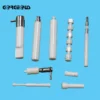
Porcecore can review a zirconia plunger-rod drawing, sample or application brief and help structure the questions that matter for quotation. The pictured or described component should be treated as an RFQ subject, not as a stated inventory item or guaranteed Porcecore-made part.
Key Inquiry Requirements
Define the plunger rod around its working motion
Start with the motion rather than the material label. An RFQ should show the rod’s overall profile, effective stroke, guided length, exposed length and the surfaces that contact seals, sleeves, liquids or powders. Identify whether the component pushes, meters, isolates or positions another part. These details determine which diameters, end forms, transitions and datum references need controlled definition on the drawing.
A solid rod may appear simple, yet its ends can carry the most important functional detail. Specify whether the plunger needs a flat face, radius, chamfer, groove, shoulder, hole, threaded interface or a separate mating piece. Mark every functional surface and state which dimensions are basic, critical or reference-only. If the rod is guided through a close assembly, include the mating component and its inspection method in the RFQ package.
Compare zirconia options by application evidence
Zirconia is a material family, not a complete specification. Ask suppliers to identify the proposed grade or formulation, shaping route and finishing approach, then compare those details against the actual duty cycle. The relevant questions may include contact media, reciprocation rate, loading direction, impact exposure, lubrication, cleaning chemistry and whether electrical isolation or nonmetallic contact is part of the design intent.
Avoid selecting a rod from a headline strength statement alone. Request material documentation tied to the quoted grade, together with representative dimensional and surface inspection records where appropriate. Compare how each proposal addresses edge integrity, straightness, cylindricity, end-face condition and possible damage from handling. Any claimed service suitability should be reviewed against the complete assembly and operating sequence, not treated as a blanket guarantee.
Control interfaces, finish and cleanliness
For a plunger rod, interface quality can matter more than visible appearance. Define the guide fit, seal-contact zone, end-face relationship and allowable edge condition in language that can be inspected. If a polished or ground region is needed, identify its location and purpose rather than requesting an undefined premium finish. Provide the mating drawing so the supplier can distinguish functional surfaces from cosmetic ones.
Cleanliness requirements should reflect the process in which the rod will be installed. State whether the part enters a vacuum system, fluid path, powder-handling area, sterile process, analytical instrument or general mechanism. Include packaging, marking, particulate control and cleaning expectations when they affect acceptance. If the component must remain free from metallic contamination or residues, define the verification evidence required instead of relying on an unqualified cleanliness phrase.
Inspect the features that determine fit
A useful inspection plan separates measurable drawing requirements from supplier process controls. For the rod, consider checking critical diameters, total length, end geometry, straightness, runout, cylindricity, surface condition and the relationship between functional datums. The exact controls should follow the approved drawing; do not add numerical tolerances merely because a ceramic rod resembles a familiar metal part.
Ask how inspection results will be recorded and connected to the supplied parts. A first-article report, dimensional record, material identification or visual inspection record may each answer a different question. Where the rod has a long slender geometry, clarify support during measurement and the reference condition. This prevents disagreements caused by comparing results taken with different fixturing, instruments or datum interpretations.
Build a quotation package that reduces assumptions
Send the supplier a controlled drawing, revision identifier, quantity scenario and application summary. Add the mating guide, seal information, loading description and any available failure history. State which requirements are mandatory and which are open for engineering review. If the design is still evolving, ask for a manufacturability review that identifies risks without silently changing the intended geometry.
The RFQ should also request the proposed material designation, process route, achievable feature definition, inspection scope, packaging approach and clarification list. Ask suppliers to separate confirmed compliance from recommendations and unresolved assumptions. This creates a useful basis for comparing proposals on technical fit, documentation and risk, while leaving dimensions, tolerances, commercial terms and delivery commitments to the formal quotation and approved specification.
Questions Before You Inquire
What should accompany a zirconia plunger rod RFQ?
Provide a controlled drawing with datums, functional surfaces and revision status, plus the mating guide or seal information. Explain motion, load direction, contact media, cleaning conditions and inspection expectations. If the design is preliminary, identify open decisions so suppliers can flag manufacturability issues rather than making silent assumptions.
Should the rod be specified only by diameter and length?
Usually not. End geometry, straightness, cylindricity, runout, guide or seal interfaces, edge condition and cleanliness may affect operation just as much as basic size. Specify each feature according to its function, and show how it relates to the assembly datums and acceptance inspection.
How can zirconia proposals be compared fairly?
Request the proposed zirconia grade, forming and finishing route, inspection scope and supporting material documentation. Compare those items against the same duty-cycle information and drawing revision. Treat general property statements as screening information only; suitability depends on the complete assembly, environment and defined acceptance criteria.
Can Porcecore quote from a sample alone?
A sample can support an initial review, but a controlled drawing or measured sample definition is preferable. Include critical interfaces, intended use, quantity scenario and inspection needs. The final quotation should identify assumptions, proposed material and unresolved details before any production commitment is considered.
Send a Clear Component Brief
Share your drawing, quantity and application with Porcecore. Mark the requirements that are fixed and the questions that remain open.


Reviews
There are no reviews yet.