
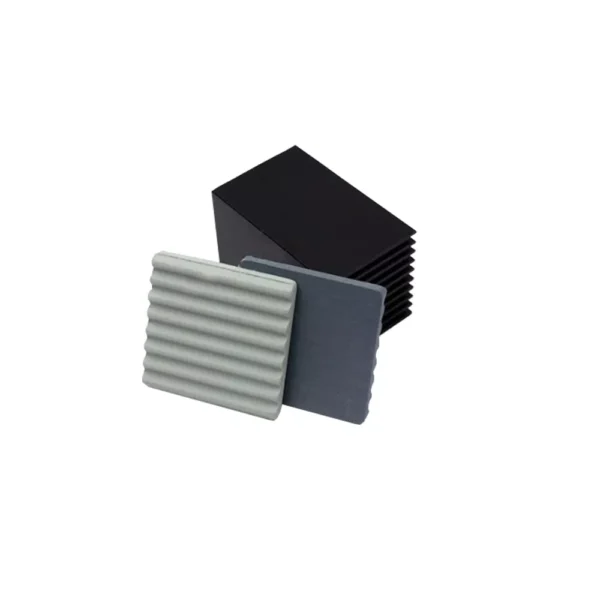


Build the RFQ around heat flow, attachment, geometry, environment and inspection so candidate designs can be compared on the same technical basis.
Key Inquiry Requirements
Heat-sink function and application context
A silicon carbide heat sink is normally evaluated as part of a thermal assembly, not as an isolated block. Its effectiveness depends on how heat enters the ceramic, how it leaves the assembly, how the part is restrained and how surrounding air, fluid or process media interact with its surfaces. Explain the heat source, duty pattern, neighboring hardware and allowable interface conditions in the RFQ.
The component may require a flat base, fins, channels, mounting holes, pockets or another custom profile, but the appropriate form should follow the application drawing. Identify which surfaces are thermally functional and which are used for fixing, insulation or handling. Include the assembly orientation and any restrictions on envelope, mass, electrical isolation or cleaning so the supplier can assess the complete design intent.
Thermal requirements without unsupported promises
Do not define the requirement only by naming silicon carbide or calling the part a high-performance heat sink. State the heat-load description, source footprint, contact method, operating cycle, ambient or process conditions and the temperature limits relevant to the assembly. If thermal resistance, temperature uniformity or transient response will be evaluated, describe the test arrangement and measurement points.
Material selection and geometry must be reviewed together. A supplier may need to consider the ceramic grade, density, surface finish, wall thickness, feature spacing and joining or interface method. Ask for the basis of any thermal data, including specimen configuration and test conditions, so values are not compared across incompatible methods or mistaken for a guarantee in the final installation.
Interface, mounting and mechanical design
The heat sink drawing should show the heat-source contact area, mounting pattern, fastener clearances, compression zones and any compliant interface layer. Ceramic can be damaged by uneven clamping, local bending or differential expansion between materials. Provide the fastening sequence, contact pressure expectations, support scheme and any requirement for electrical isolation or controlled grounding.
If the sink includes fins, channels or thin projections, identify handling constraints and cleaning access. State whether the part will see vibration, shock, pressure, flow or repeated assembly. These conditions can influence feature spacing, corner treatment and support locations. A good RFQ invites the supplier to review the design for manufacturability and assembly risk before commercial terms are finalized.
Surface condition and inspection
Thermal interfaces often depend on surface condition, so specify the relevant flatness, roughness, waviness, cleanliness and allowable visible damage only when those characteristics are genuinely critical. Define the datum structure and measurement locations. If the sink contains channels or enclosed features, also state how blockage, debris or internal continuity should be checked before acceptance.
Inspection should connect the drawing to the intended thermal test, if one is required. Ask suppliers to separate dimensional inspection, visual inspection, material documentation and functional evaluation. A sample test may be useful for a new geometry, but its fixture, heat source, boundary conditions and acceptance criteria must be agreed in advance to make the result meaningful.
Preparing a comparable heat-sink RFQ
Include the heat-source sketch, assembly drawing, thermal duty profile, mounting details, surrounding materials and expected quantity pattern. Add the target envelope, critical interfaces, cleaning and packaging requirements, and any restrictions created by the installed equipment. If the design is still being developed, clearly label open dimensions and ask for a technical review rather than allowing suppliers to make silent assumptions.
Request a quotation that identifies the proposed silicon carbide grade, production route, finishing operations, inspection scope and excluded services. Ask how the supplier would manage warpage, edge damage, feature cleanliness and interface protection. Compare responses according to how clearly they address the thermal assembly and the verification plan, not merely the component name or a headline material claim.
Questions Before You Inquire
What thermal data should accompany a silicon carbide heat-sink RFQ?
Describe the heat source, contact footprint, duty cycle, operating environment, mounting arrangement, allowable temperatures and intended measurement points. If a thermal-resistance or temperature-uniformity target is used, define the complete test fixture and boundary conditions. Without that context, supplier data may describe a different specimen or assembly.
Can a silicon carbide heat sink replace a metal heat sink directly?
Not automatically. The replacement must be reviewed for heat flow, interface flatness, fastening, differential expansion, electrical behavior, weight, cleaning and available space. Provide the existing assembly and the reason for considering ceramic. The supplier can then identify geometry changes, interface requirements and validation work needed before adoption.
Which dimensions should be marked critical on the drawing?
Mark the heat-source contact area, mounting locations, envelope limits, datum surfaces, feature spacing, channel or fin geometry and any alignment interfaces that affect assembly. Add surface-condition requirements where thermal contact depends on them. The supplier should review the remaining dimensions for manufacturability and propose clarification where needed.
How can heat-sink quotations be evaluated fairly?
Use the same heat-load definition, interface condition, mounting method and inspection expectations for every quotation. Compare material grade, geometry feasibility, manufacturing route, thermal evidence, documentation and stated exclusions. Confirm whether cleaning, finishing, testing and packaging are included, because those items can materially change technical comparability.
Send a Clear Component Brief
Share your drawing, quantity and application with Porcecore. Mark the requirements that are fixed and the questions that remain open.

Reviews
There are no reviews yet.