

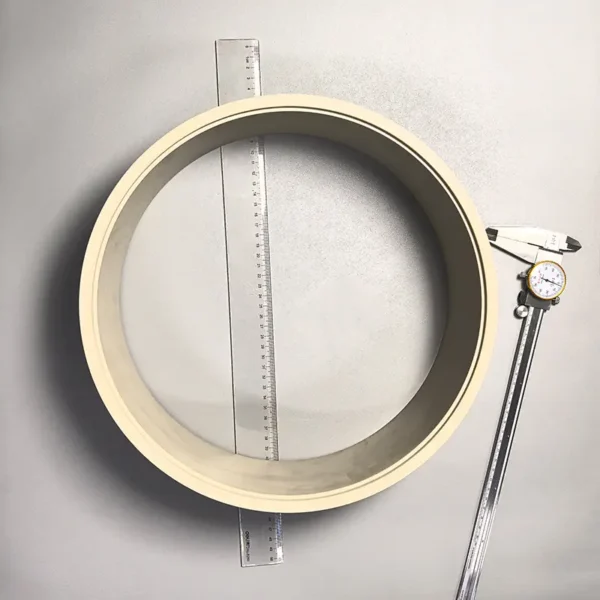


Use this page to prepare a precise RFQ for an aluminum nitride ring, washer, or related large circular form. Share the complete drawing, material expectations, inspection requirements, joining method, and application environment so suitable manufacturing and verification routes can be compared.
Key Inquiry Requirements
Design intent for a large aluminum nitride circle
A large circular aluminum nitride component may serve as an insulating structural element, thermal-management interface, spacer, cover, or washer-like part. Its role depends on the surrounding assembly, so the RFQ should explain which surfaces contact metal, which regions remain exposed, and whether the component carries compression, alignment, clamping, or sealing loads during use.
Describe the operating sequence as well as the nominal geometry. Buyers should identify assembly temperature changes, electrical isolation points, contact materials, mounting direction, and any exposure to vacuum, atmosphere, moisture, chemicals, or particles. These details help suppliers judge whether the proposed ceramic form and finishing plan are appropriate for the real duty rather than only for a static drawing.
Drawing information buyers should define
A useful drawing should identify outside and inside geometry, thickness, datums, reference surfaces, hole or slot features, edge breaks, and any zones that must remain free from chips or grinding marks. If the circle is used as a locating or mating part, indicate the functional fit and contact areas directly instead of relying on a general note.
Large ceramic circles can be sensitive to handling and machining strategy, particularly where broad faces meet thin sections or interrupted features. State the critical characteristics separately from noncritical cosmetic requirements. Include allowable flatness, parallelism, concentricity, runout, surface condition, and inspection method only when those values are genuinely required by the assembly.
Material and thermal-electrical questions
Aluminum nitride is commonly considered where heat movement and electrical insulation must be addressed together. The RFQ should distinguish a thermal path from a heat-spreading expectation, and should show how the component is clamped, bonded, metallized, or left electrically isolated. Without that context, a material discussion can be technically correct yet commercially unhelpful.
Ask suppliers to state the proposed material grade, available property data, test basis, and permitted variation for the application. If thermal or dielectric behavior is a release characteristic, define the measurement method and sampling plan. Do not substitute a catalogue headline for an agreed acceptance criterion, especially when the circular part forms one element of a larger thermal stack.
Manufacturing, finishing and inspection
The production route should be evaluated against the part’s largest span, section changes, openings, and required surface condition. Buyers can ask whether forming, sintering, grinding, lapping, drilling, or other operations are expected, but should leave the supplier room to recommend a route consistent with the approved drawing and material choice.
Inspection planning should cover dimensions, visible damage, surface condition, and any application-specific characteristics such as electrical isolation or thermal response. Request representative inspection records or a proposed control plan when the component is safety-critical or difficult to access after assembly. Define packaging and handling expectations because edge damage can occur after final inspection if protection is not specified.
What to include in the RFQ
Send a native drawing or clear PDF together with revision status, annual or project quantity assumptions, prototype versus repeat-production intent, and the intended assembly process. Add mating-part drawings where they control fit, clamping, sealing, or heat transfer. If no value is known, identify the function and ask for a design review rather than inserting an arbitrary tolerance.
A strong RFQ also identifies sample approval, documentation, traceability, inspection lot definition, and nonconformance handling. Ask for clarification of assumptions before quotation, including any geometric limitation created by the large circular format. This creates a comparable technical response and makes later drawing changes easier to control.
Questions Before You Inquire
What should a buyer send when requesting a quote for this component?
Provide the latest drawing, material family, revision, quantity context, mating-part information, operating environment, and required inspection scope. Explain the component’s function in the assembly, especially whether it provides insulation, heat transfer, alignment, spacing, or support. A drawing alone may not reveal the critical performance or handling risks.
Is this aluminum nitride ceramic circle an inventory item?
This page should be treated as a custom RFQ topic, not an inventory promise. Availability, tooling, process route, and acceptance capability depend on the approved geometry and requirements. Ask the supplier to review the drawing and confirm what can be proposed before making assumptions about supply, repeatability, or commercial terms.
Which characteristics are often important for a large circular ceramic part?
Buyers commonly review fit, flatness, parallelism, concentricity, edge integrity, surface condition, insulation requirements, and any defined thermal characteristic. The correct list depends on the assembly. Mark functional characteristics on the drawing and connect each one to a measurement method so inspection results can be interpreted consistently.
Can the component be combined with metal or other materials?
It may be integrated with metal hardware, bonding layers, or adjacent ceramics, but the joining and clamping design must be reviewed as a system. Provide contact materials, joining temperatures if relevant, load direction, and thermal cycling information. The supplier should confirm a proposed interface approach rather than assume compatibility from material names alone.
Send a Clear Component Brief
Share your drawing, quantity and application with Porcecore. Mark the requirements that are fixed and the questions that remain open.


Reviews
There are no reviews yet.