
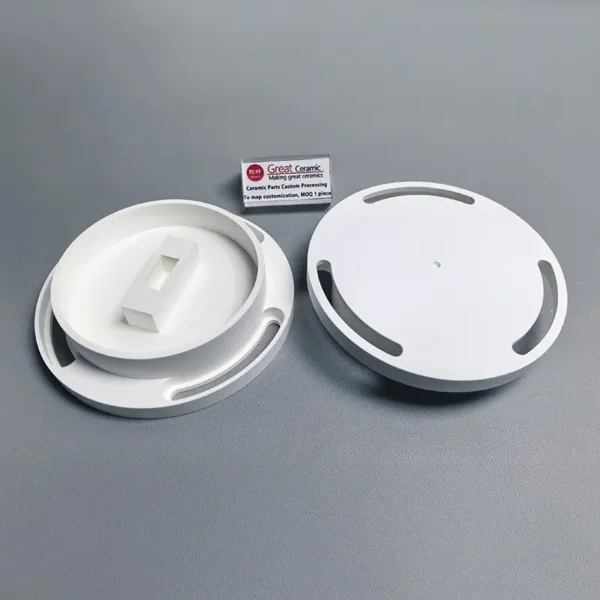
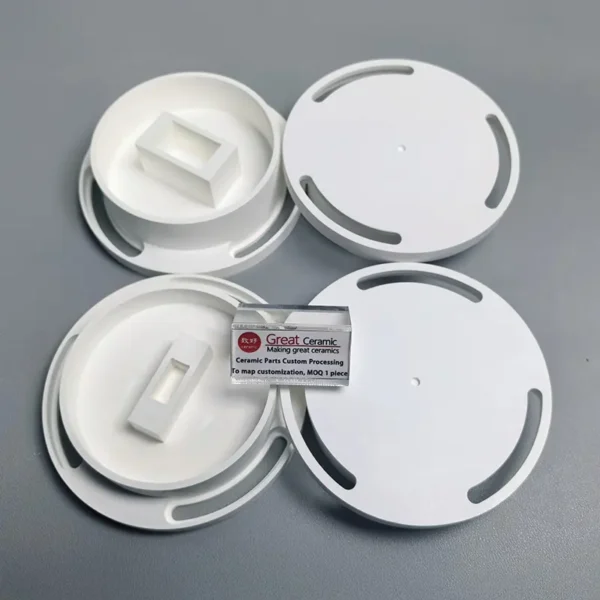
Treat the disc as a shaped component rather than a generic round blank. Provide feature profiles, orientation references, mating conditions and service context so an RFQ can address the actual part design.
Key Inquiry Requirements
Disc geometry and feature hierarchy
A boron nitride ceramic parts disc may combine a circular outer boundary with grooves, tabs, recesses or raised central features. Define each feature from controlled datums and explain its functional role. The drawing should distinguish locating surfaces, contact faces, clearance regions and nonfunctional contours, because the inspection and processing attention may differ across this compact but highly shaped component.
Use section views to describe curved grooves, hemispherical or domed structures, local thickness changes and transitions that a top view cannot resolve. Identify orientation marks or asymmetric features if the disc can be installed incorrectly. A three-dimensional model may support communication, but the controlled drawing should remain the authority for dimensions, references and revision status.
Interfaces, orientation and assembly
Explain how the disc is held, positioned, contacted or exposed in the assembly. A center tab, outer ring or shaped groove may control orientation, load transfer, spacing or clearance, but the supplier should not be expected to infer that purpose. Provide mating-part details, assembly sequence and any restrictions on contact, clamping, adhesives or joining when they influence the finished geometry.
If the disc is used near dissimilar materials, describe the relevant interfaces and movement conditions. Note whether surfaces must remain free of damage, whether edges are shielded or exposed and whether the component is handled by a dedicated fixture. These details help suppliers review feature robustness and propose an inspection approach suited to the actual installation.
Material and surface-condition review
Request confirmation of the proposed boron nitride material designation and available technical documentation for the quoted configuration. The material family alone does not define surface condition, feature integrity or compatibility with the intended process. State whether the disc acts as an insulator, separator, support, release surface or thermal component, then identify which properties require application-specific review.
Describe finish expectations in functional terms where possible: contact behavior, cleanliness, freedom from chips, visual uniformity or protection during handling. Do not add unverified numerical limits. If a surface texture or treatment is essential, place it on the drawing and explain its purpose. This enables a supplier to distinguish required evidence from preferences that can be discussed during design review.
Inspecting complex disc features
Inspection should address both the circular base geometry and the distinctive shaped features. Consider outer profile, center feature position, groove form, local heights, thickness relationships, edge condition and visible defects. Select datum references that mirror assembly use, and specify which dimensions require recorded results. A general diameter check will not establish whether an asymmetric functional disc is correctly made.
Ask for a proposed measurement method where curved or recessed features are difficult to access. The supplier should identify any limitations in probing, fixturing or optical inspection and explain how results will be reported. If cleanliness or packaging protects delicate geometry, include those requirements in the acceptance plan rather than treating them as informal handling preferences.
RFQ structure for shaped ceramic discs
Include the controlled drawing, section views, orientation details, assembly context, revision level and quantity scenario. Identify whether the request supports prototype review, qualification or repeat sourcing. Add any relevant handling, identification, cleanliness and packaging notes, especially where grooves, tabs or raised features could be damaged before installation.
Request a response covering material information, processing assumptions, feature feasibility, inspection scope and deviations from the drawing. Ask suppliers to flag any geometry that may need adjustment and to separate those recommendations from firm compliance statements. This gives the buyer a traceable basis for comparing technical proposals without implying stock availability, guaranteed performance or an unreviewed standard design.
Questions Before You Inquire
Why is a shaped boron nitride disc different from a simple ceramic disc?
Its functional behavior may depend on asymmetric tabs, grooves, raised areas, recesses and orientation. Those features create additional datum, inspection and handling needs that a simple diameter-and-thickness description cannot capture. The RFQ should define the full profile and show how each feature relates to the mating assembly.
What drawings are useful for a complex disc component?
Provide a controlled dimensioned drawing with sections through curved or raised features, datum references and orientation information. An assembly view and three-dimensional model can clarify interfaces, but the drawing should govern acceptance. Include details for edges, transitions, contact surfaces and any areas that must remain protected during handling.
How should delicate disc features be covered in inspection planning?
List the feature dimensions and relationships that affect installation, then connect them to practical measurement methods. Include groove form, raised-feature position, local height, thickness and edge condition where relevant. Ask the supplier to disclose access or fixturing limitations and define how visual and dimensional findings will be reported.
Can the supplier choose the boron nitride grade?
The supplier may propose a grade or material route, but the buyer should require the offered designation and supporting documentation before approval. Explain the application and identify characteristics that matter. Any alternative should be reviewed against the drawing, service conditions, interfaces and validation plan rather than accepted from a generic material label.
Send a Clear Component Brief
Share your drawing, quantity and application with Porcecore. Mark the requirements that are fixed and the questions that remain open.


Reviews
There are no reviews yet.