
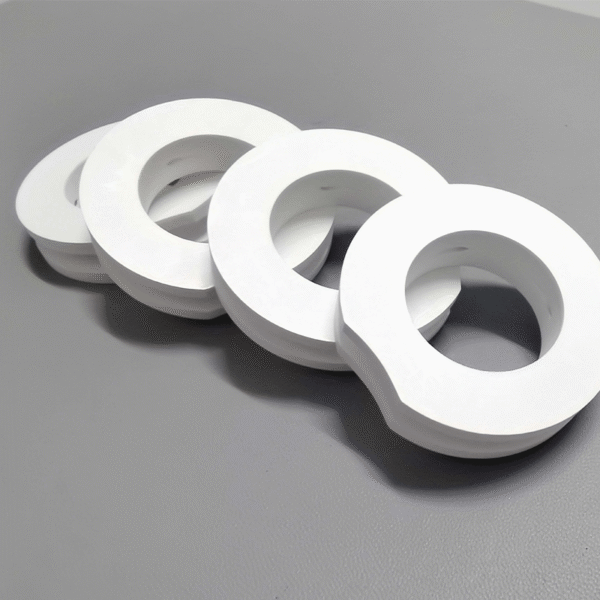


Specify the ring’s load path, mating surfaces, clearances, thermal role and inspection basis. Compare proposals through the drawing and application conditions, not a material name alone.
Key Inquiry Requirements
Start with the ring’s assembly role
Boron nitride ceramic rings can serve different purposes within thermal, electrical or mechanical assemblies, so the RFQ should begin with the ring’s actual job. Identify whether it spaces, insulates, supports, shields, locates or separates another component. Show the mating parts, compression direction, exposed surfaces and assembly sequence on the drawing or in a short application note.
The ring should be described as part of an interface, not as an independent washer. Define the inside and outside boundaries, contact faces, shoulder relationships and any retention method. Explain whether the part is installed once or replaced during service. This context allows suppliers to review edge conditions, handling risks, fit and inspection priorities around the complete assembly.
Material selection and thermal intent
When requesting boron nitride rings, state the material family and the property categories that matter to the application. These may include thermal stability, heat transfer behavior, electrical insulation, chemical environment and dimensional response during the operating cycle. Ask suppliers to identify the proposed grade or material designation and to explain any relevant processing or finishing considerations.
Avoid treating a broad material label as a complete specification. If the ring interfaces with a heater, electrode, sensor, vessel or hot-zone component, describe the surrounding materials and the direction of heat flow. State whether thermal contact, isolation or controlled spacing is the priority. Suppliers should identify assumptions and any material substitution before quotation, not after the part enters assembly.
Geometry, fit and contact surfaces
The drawing should define bore size, outside diameter, thickness, shoulders, steps, slots, holes and orientation features as applicable. Identify the datums that govern concentricity, face relationship and assembly location. Mark surfaces that carry load or establish an electrical gap, and state whether edge breaks, lapping, polishing or a particular visual condition is required.
Fit should be considered at the complete temperature and assembly condition described by the buyer. Explain whether the ring is clamped, lightly located, bonded, nested or captured, and identify any neighboring material that can constrain movement. Where the design depends on a clearance, do not leave the intended function implicit; define the reference condition and ask suppliers to review the interface.
Inspection and handling controls
Ceramic rings can be sensitive to chips, cracks, contamination and careless handling at thin sections or sharp transitions. The RFQ should identify visual acceptance areas, protected edges, cleanliness expectations and packaging requirements. If a face must remain suitable for intimate contact, mark it as a functional surface and describe the inspection method used to assess it.
Dimensional inspection should follow the drawing’s datum structure. Specify the characteristics to report, including bore, outside boundary, thickness, step position or hole location where relevant. State whether inspection records are required for every part, a sample or a defined batch. This makes supplier responses easier to compare while leaving unrequested tolerances and acceptance values for the buyer to establish.
Build a complete ring RFQ
Include the assembly drawing, part drawing, revision, material preference, operating environment and installation instructions. Add thermal cycling, electrical isolation or chemical exposure information when those conditions influence selection. If the ring is one of several similar sizes, show the family relationship and identify whether interchangeability, orientation or traceability matters across the group.
Ask for a proposal that lists material designation, manufacturing route, machining or finishing operations, inspection method, packaging and all deviations. Request questions on thin walls, concentric features, sealing faces and mating clearances. The strongest comparison will show how each proposal addresses the ring’s actual assembly function, documentation needs and revision control rather than simply repeating boron nitride terminology.
Questions Before You Inquire
What is the most important information for a boron nitride ring RFQ?
Describe the ring’s role, mating components, load direction, electrical or thermal function, temperature environment, installation method and critical geometry. Include a controlled drawing with datums and surface notes. If the ring must maintain a gap or provide a contact face, define that function explicitly and identify the inspection evidence expected.
How should material requirements be written?
Name boron nitride as the preferred material family, then identify the property categories that drive the choice, such as insulation, thermal behavior, stability or chemical exposure. Ask suppliers to state the proposed grade, processing route and any substitution. This keeps the comparison technically useful without inventing values or accepting an undefined generic label.
Should thin edges and chips be addressed in the specification?
Yes. Mark vulnerable edges, functional faces and transition areas on the drawing, then describe the visual and handling condition required. If a particular edge treatment is needed, define it. Packaging should also be included because protection during handling and transit can affect whether the ring arrives suitable for assembly inspection.
Can several ring sizes share one RFQ?
They can if the family relationship is clear. Provide a schedule identifying each size, drawing revision, quantity context and any differences in material, finish or inspection. State whether the parts must be interchangeable or merely similar. A common RFQ should still preserve individual identifiers and prevent dimensions from being inferred between variants.
Send a Clear Component Brief
Share your drawing, quantity and application with Porcecore. Mark the requirements that are fixed and the questions that remain open.


Reviews
There are no reviews yet.