

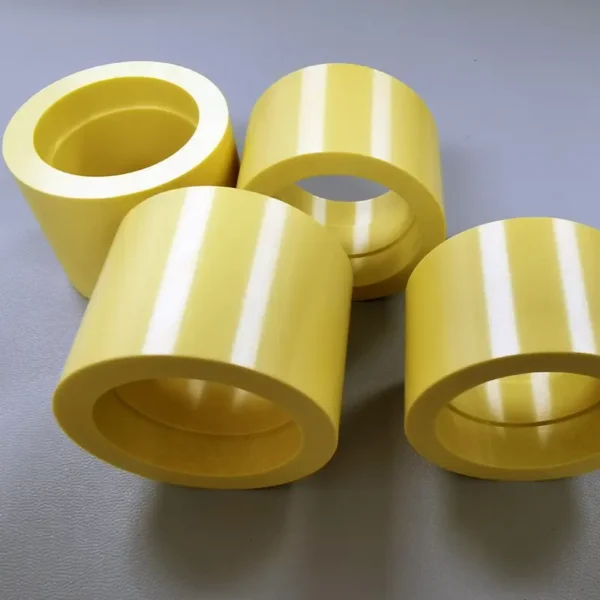

Define the ring by drawing, interface conditions and inspection requirements rather than by a catalogue label. Porcecore can review the intended application and prepare an RFQ basis around your documented requirements.
Key Inquiry Requirements
Ring geometry and fit
A ceramic ring should be specified through its complete geometry, including internal and external diameters, axial thickness, edge treatment, grooves, steps and any datum scheme shown on the drawing. The buyer should identify which surfaces establish alignment, sealing, spacing or electrical isolation. If the ring interfaces with metal, glass or another ceramic, include mating dimensions and assembly sequence so fit can be evaluated as a system.
Do not rely on a nominal ring size when the component affects a precision assembly. State the drawing revision, measurement datums, allowable form variation and inspection points that matter to installation. Where dimensions are still under development, provide the functional envelope, mating-part information and intended adjustment strategy. This gives the RFQ a clear path from concept geometry to manufacturable review without implying an unverified tolerance.
Material definition
Magnesia-stabilized zirconia should be treated as a material family requiring confirmation of grade and processing route. The RFQ should request the proposed composition designation, forming method, sintering approach and any finishing operations relevant to the ring. Buyers should also state whether the part will face thermal cycling, mechanical contact, vacuum, chemicals or contamination-sensitive service.
Material comparison should focus on the actual duty of the ring rather than a broad claim about zirconia. Ask suppliers to identify relevant material data, test methods and condition of measurement for the application. If a substitute ceramic is acceptable, define the performance boundary and approval process; otherwise, state that the specified material family is mandatory and requires documented confirmation.
Manufacturing and finishing
Ring production may involve near-net forming followed by controlled finishing of critical surfaces. An RFQ should distinguish as-formed surfaces from machined surfaces and identify where grinding, lapping, chamfering or edge cleanup is permitted. Include requirements for chips, cracks, stains, surface damage and residual particulate, especially when the ring will be installed inside a controlled assembly.
Ask for a manufacturing review before quotation when the geometry includes thin walls, interrupted profiles, narrow steps or closely related concentric features. The supplier should explain feasible inspection access and identify any drawing features that need clarification. This review is particularly useful when the ring must be handled repeatedly, aligned against a shoulder or joined to another component.
Inspection and documentation
Inspection planning should connect each critical drawing feature to a practical measurement method. Specify whether diameter, thickness, concentricity, flatness, roundness, edge condition or visual quality requires reporting, and identify the sampling basis requested for production lots. If a full inspection report is needed, define its format, units, reference drawing and acceptance criteria before quotation.
Documentation should separate confirmed results from supplier process information. A useful RFQ package can request material identification, dimensional records, visual inspection findings, packing details and any agreed deviations. Avoid asking for unspecified certificates as a substitute for requirements; instead, describe the evidence needed to release the ring into the next assembly or qualification step.
RFQ preparation
A clear inquiry should include the latest drawing, three-dimensional model if available, annual or project quantity range, prototype status, application environment and required delivery destination. State whether the quoted part is for feasibility review, sample evaluation, pilot production or recurring manufacture. These details help suppliers judge tooling, inspection effort and communication needs without turning an early inquiry into an inventory assumption.
Before comparing offers, align the scope of material, finishing, inspection, packaging and deviation approval. Ask each supplier to list exclusions, open technical questions and proposed alternatives separately from the base quotation. This makes prices and technical responses easier to compare while preserving the buyer’s authority over geometry, material selection and acceptance decisions.
Questions Before You Inquire
What should accompany an RFQ for a ceramic ring?
Provide the latest drawing, mating-part details, material requirement, application environment, quantities by project stage, inspection expectations and delivery destination. If the design is incomplete, include the functional envelope and identify which dimensions are provisional so suppliers can respond with clear assumptions and questions.
Is magnesia-stabilized zirconia interchangeable with another ceramic?
Not automatically. Interchangeability depends on the ring’s mechanical, thermal, chemical, electrical and dimensional duties. If alternatives are allowed, define the acceptance boundary and approval process. Otherwise, request confirmation of the specified material family and ask suppliers to identify any proposed deviation before quotation.
Which ring features usually need special inspection attention?
The relevant features depend on the assembly, but buyers commonly identify mating diameters, thickness, concentricity, flatness, edge condition and visible damage. The drawing should mark critical characteristics and specify measurement references. Suppliers should then confirm practical inspection methods and reporting scope.
Can a supplier quote before the drawing is final?
Yes, for a feasibility or budgetary review, provided the response clearly labels assumptions and excludes a production commitment. Supply the current geometry, known interfaces, material intent and unresolved items. A final quotation should follow once the drawing, inspection criteria and deviation process are agreed.
Send a Clear Component Brief
Share your drawing, quantity and application with Porcecore. Mark the requirements that are fixed and the questions that remain open.


Reviews
There are no reviews yet.