


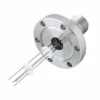

Build the RFQ around the complete feedthrough or connector interface. Define pin layout, body geometry, mating conditions, electrical design inputs, environmental exposure and documentation needs without assuming stock availability, standardization or guaranteed performance.
Key Inquiry Requirements
Multipin connector scope
A multipin connector can combine a ceramic insulating body with several conductive paths and a mounting interface. Its suitability depends on how the assembly is built, accessed and maintained. Explain whether the part functions as a connector, feedthrough, terminal interface or sealed boundary, and identify which surfaces must mate with a housing, cable, board, chamber or fixture.
The component name does not define the finished configuration. Specify the number and arrangement of positions, pin orientation, contact style, body outline, keying and retention method required by the assembly. If some positions are unused or have different functions, show that distinction on the drawing. This prevents a quotation from silently assuming a uniform or standard layout.
Pin layout and mating details
Pin location and protrusion control are often central to assembly success. Provide a coordinate system, pitch or positional relationships, pin diameters or profiles where defined, and the mating direction. Show reference datums and any nonuniform pattern clearly. Include access clearances for tools, seals, soldering, crimping or fastening if those operations occur near the connector.
The ceramic body must be reviewed with the pin and housing interfaces together. Identify shoulders, grooves, mounting holes, keyways, locating faces and retention features. If the connector must be removable, describe the mating and unmating sequence. If it is permanently installed, state the attachment or sealing assumptions so the supplier can evaluate stresses and process compatibility.
Electrical and environmental requirements
Describe the electrical role of each path at the level required for design review, including isolation relationships, contact sequence and any routing constraints. Do not insert assumed voltage, current, frequency or insulation values. Instead, state the design inputs and the evidence needed to verify them. The supplier can then identify which material, pin and body details require additional review.
Environmental information should cover the actual boundary the connector crosses. Consider pressure differential, vacuum, moisture, chemicals, cleaning agents, vibration, thermal cycling and nearby heat sources where relevant. Also state whether sealing, outgassing, particle control or corrosion resistance matters. These inputs guide the discussion without turning broad application language into an unsupported performance guarantee.
Inspection and qualification evidence
Inspection should cover the connector as an assembled interface: pin position, orientation, protrusion, body dimensions, mounting features, visual condition and relevant surface requirements. Define how mating fit will be checked and whether sample assembly is part of approval. If a seal or attachment process is included, identify its inspection evidence separately from dimensional checks on the ceramic body.
Ask suppliers to identify proposed materials, pin or body processing, joining methods and available documentation. Depending on the application, the buyer may request dimensional reports, material records, cleanliness evidence or agreed electrical and environmental verification. Each request should reference a defined requirement, test condition or acceptance criterion rather than an undefined claim of reliability.
Writing a multipin connector RFQ
Provide an assembly drawing, connector detail drawing, mating-interface information, electrical design inputs and application environment. State whether the design is exploratory, a replacement, or intended for a new assembly, and identify any preferred integration constraints. Include packaging and identification needs when connector orientation or cleanliness must be preserved through handling.
Compare quotations for completeness across the entire interface. Review pin layout interpretation, body and mounting features, joining or sealing scope, inspection, documentation and unresolved assumptions. Confirm whether sample fitting, engineering review or tooling is included. A clear commercial and technical boundary helps buyers evaluate custom proposals without assuming inventory, standard lead time or interchangeable construction.
Questions Before You Inquire
What does a multipin connector RFQ need first?
Start with the assembly context, connector function, pin count and layout, mating direction, body outline and mounting method. Add electrical design inputs, environmental exposure, sealing or cleanliness needs and inspection evidence. Mating-part drawings are important because connector dimensions cannot be evaluated independently from the receiving interface.
Are ceramic multipin connectors standard components?
Some connector concepts may resemble standard interfaces, but the required pin pattern, body, mounting, sealing and environmental conditions can make the design application-specific. Do not assume interchangeability or stock status. Provide a drawing and request confirmation of the proposed configuration, scope and unresolved technical assumptions.
Which environmental details should buyers disclose?
State relevant pressure, vacuum, moisture, chemicals, cleaning, vibration, thermal cycling, heat exposure and particle-control conditions. Explain whether the connector crosses a sealed boundary or enters a controlled space. The supplier needs these details to review the body, pins, joining method, packaging and requested verification evidence.
How should multipin connector quotations be compared?
Compare pin layout, body and mounting geometry, mating fit, joining or sealing scope, material documentation, inspection and environmental verification. Check what is excluded and whether samples or tooling are included. A complete comparison should cover the whole interface, not only the ceramic body or the number of pins.
Send a Clear Component Brief
Share your drawing, quantity and application with Porcecore. Mark the requirements that are fixed and the questions that remain open.


Reviews
There are no reviews yet.