




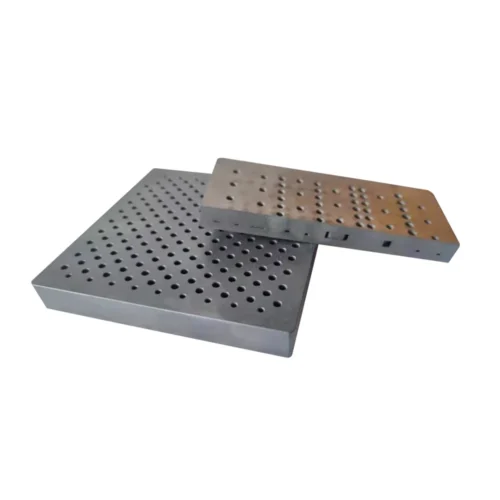
Use this page to prepare an RFQ for a silicon carbide ceramic vacuum chuck used to hold delicate workpieces through a vacuum interface. The supplied excerpt references drawing-based customization, isostatic pressing, high-temperature sintering and semiconductor processes such as photolithography, etching, laser processing and wafer inspection. Final requirements still depend on the buyer’s design and process.
Key Inquiry Requirements
Define the chuck and workpiece interface
Start with the complete chuck geometry and the workpiece it must support. Provide outside form, thickness, mounting features, datum scheme, pocket or step geometry, vacuum zones, ports, grooves, holes and edge treatment. Identify the contact surface and any exclusion areas. Include the latest drawing revision, coordinate origin and orientation so the chuck can be reviewed as a process component rather than a generic plate.
Describe the workpiece format and handling sequence without assuming that a named semiconductor process defines the design. State the supported surface, allowable contact regions, loading direction, transfer method, alignment features and whether the workpiece is fragile, thin, patterned or otherwise sensitive. These details guide review of surface geometry, vacuum layout and edge protection while keeping the RFQ tied to the actual tool interface.
Clarify vacuum and process conditions
Provide the vacuum architecture that belongs to the chuck: port locations, channel or hole layout, seals, fittings, manifolds, connection direction and the intended interface to the vacuum generator. State the required operating range and response criteria only when they are defined by the process. Also identify pressure cycling, atmosphere, temperature exposure, cleaning chemistry and any plasma, laser or etch environment relevant to material review.
A vacuum chuck should be evaluated with the workpiece, sealing scheme and process sequence in view. Explain how leakage, particle control, outgassing, residue or contact marks will be assessed if they matter. Do not use contamination-free or holding claims as specifications by themselves. Convert them into measurable inspection or process acceptance requirements, with test conditions and boundaries defined in the RFQ.
Review silicon carbide body and finish
Silicon carbide is a material family, not a complete chuck specification. Ask the supplier to state the proposed material basis, forming or fabrication route, sintering or finishing assumptions and relevant documentation. The supplied evidence references isostatic pressing and high-temperature sintering, but buyers should confirm which process route applies to the quoted design and which characteristics are controlled after finishing.
Mark the functional surfaces and define the finish requirements that affect contact, sealing, alignment or particle behavior. Include flatness, parallelism, surface texture, hole quality, edge condition or other controls only where they are necessary, and connect each to a measurement method. If coatings, inserts, seals or metal fittings are included, separate them from the ceramic scope and identify their interfaces and responsibilities.
Prepare a process-aware RFQ
Include the tool interface, mounting envelope, workpiece map, vacuum schematic, cleaning method and process sequence with the drawing package. Identify inspection access, reference surfaces, replaceable hardware and maintenance constraints. If the chuck is intended for photolithography, etching, laser processing or wafer inspection, describe the actual exposure and handling conditions rather than relying on the application label.
State development quantity, sample expectations, packaging, cleanliness documentation and any required design review gates. Mark dimensions that are frozen and features open to supplier feedback. Ask for a written list of assumptions about channels, ports, wall thickness, finishing access and assembly. This lets the supplier identify manufacturability risks without changing the chuck design silently or treating an incomplete drawing as final.
Inspect, compare and qualify
Compare quotations using the same chuck revision and process scope. Check the proposed material basis, fabrication route, machining or finishing, ports and fittings, cleaning, packaging, inspection records and exclusions. Confirm whether vacuum testing, dimensional reports or cleanliness evidence are included, and request the test setup and acceptance limits. Commercial differences are meaningful only after the quoted configuration is technically aligned.
For first-article approval, inspect the chuck against the drawing and verify the vacuum interface using the agreed workpiece and test conditions. Review flatness, contact surfaces, channels, ports, edges, cleanliness records and mounting fit. If process testing is performed, document tool configuration, workpiece, vacuum settings and sequence. Treat results as configuration-specific evidence, not as a universal holding or contamination guarantee.
Questions Before You Inquire
What should be included in a silicon carbide vacuum chuck RFQ?
Include the controlled chuck drawing, workpiece map, mounting interface, vacuum ports and channels, seals or fittings, surface requirements, process environment, cleaning method, inspection criteria, sample plan and packaging needs. Identify frozen features and open design questions so supplier feedback is traceable.
Can the chuck be quoted from a workpiece size alone?
No. Workpiece size does not define the chuck’s mounting envelope, contact zones, vacuum layout, ports, flatness, edge treatment or tool interface. Provide the complete assembly and vacuum context, plus the loading and cleaning sequence, before requesting a technically comparable quotation.
Does the source process route guarantee a specific chuck result?
No. The supplied reference mentions isostatic pressing and high-temperature sintering, but the route and controls for a quoted design must be confirmed. Ask the supplier to state the applicable process basis, finishing steps, inspection evidence and any assumptions rather than inferring performance from the route name.
How should vacuum performance be accepted?
Define the test fixture, workpiece or sealing condition, connection arrangement, vacuum measurement method, stabilization time and acceptance limits before testing. Record the exact chuck configuration and process conditions. Any holding, leakage or cleanliness conclusion should remain limited to the tested setup and approved design.
Send a Clear Component Brief
Share your drawing, quantity and application with Porcecore. Mark the requirements that are fixed and the questions that remain open.



Reviews
There are no reviews yet.