


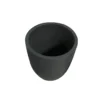

Porcecore treats this crucible as an engineered component specified against the buyer’s process, not as an inventory promise. An RFQ should make the working volume, outer envelope, opening arrangement, support method, handling conditions, inspection expectations, and acceptance criteria explicit.
Key Inquiry Requirements
Define the crucible around the process
Start with the process drawing and identify the usable cavity, wall profile, base geometry, rim configuration, and any lid or pouring interface. State whether the crucible is loaded manually, by tooling, or within an automated station. These details affect access, support, clearance, and the inspection points that matter during quotation review.
Describe the contained material and its contact conditions without assuming compatibility from the material name alone. Include melt or powder behavior, expected reactions, atmosphere, pressure, heating and cooling sequence, and cleaning practice. If the crucible is exposed to repeated campaigns, explain the cycle pattern so suppliers can distinguish one-time use from reusable service.
Compare geometry and thermal suitability
Round crucibles should be compared by functional geometry rather than nominal diameter alone. Review cavity shape, bottom transition, rim continuity, wall uniformity, flatness of the seating area, and the relationship between internal and external features. A controlled drawing gives each bidder the same reference and reduces ambiguity around usable capacity and furnace clearance.
Thermal suitability depends on the complete process window, including ramp rates, dwell periods, atmosphere changes, contact with fixtures, and cooling conditions. Ask suppliers to identify the material grade or formulation they propose and to explain how it relates to the stated service. Keep any claimed performance tied to documented evidence and agreed test conditions.
Request handling and inspection details
Because a crucible is repeatedly handled, specify lifting points, tongs, robotic interfaces, edge-clearance limits, and any visual features used for orientation. State whether the component must remain stable on a support, nest within a susceptor, or align with a cover. These practical requirements can be as important as the ceramic composition when reviewing manufacturability.
Inspection planning should identify the surfaces and features that influence use: cavity condition, rim integrity, seating behavior, visible defects, dimensional conformity, and cleanliness. If a drawing includes datum references, identify them clearly. Request the proposed inspection method, sampling basis, and report format instead of assuming that every supplier measures the same characteristics.
Build a useful RFQ package
Include a dimensioned drawing, three-dimensional model when available, revision level, estimated annual demand, order pattern, packaging expectations, and destination. Add process notes covering the contained material, atmosphere, thermal cycle, support arrangement, and cleaning restrictions. If the design is still under review, mark open dimensions and ask for manufacturability comments rather than hiding uncertainty.
Separate mandatory requirements from preferences. A clear RFQ can ask for alternative material recommendations, but it should preserve the intended geometry and process interface. Request written clarification for any deviation involving cavity dimensions, wall sections, surface condition, handling features, or inspection scope before comparing commercial responses.
Evaluate samples and production readiness
When samples are considered, use a controlled review plan tied to the drawing and process. Check fit in the furnace or fixture, loading access, seating stability, cavity cleanliness, and the condition of edges after representative handling. Record observations consistently so a visual impression does not replace dimensional and process-based evaluation.
Before approval, align on revision control, change notification, packaging, traceability, and response to nonconformance. A supplier may be able to propose a suitable route, but the buyer still owns the final process definition and acceptance criteria. Document what was reviewed, what remains unverified, and which claims require additional testing.
Questions Before You Inquire
What information should accompany an RFQ for a silicon carbide round crucible?
Provide a dimensioned drawing, cavity and envelope requirements, contained material, atmosphere, thermal cycle, support method, handling approach, cleaning practice, expected usage pattern, inspection needs, packaging requirements, and any open design questions. These inputs let suppliers evaluate the component against the process rather than quote from a product name alone.
Should the usable cavity or outside size control the design?
Both matter, but the process should establish the priority. Define the required usable cavity first, then identify furnace, fixture, cover, and handling clearances around it. Showing both functional and envelope dimensions helps suppliers understand where material may be added or removed without compromising the intended installation.
How can crucible proposals be compared fairly?
Use one controlled drawing and one process description for every bidder. Compare proposed material grade, geometry, inspection scope, packaging, stated assumptions, deviations, and evidence supporting suitability. Keep price or delivery discussions separate from unresolved technical differences, especially when cavity dimensions, wall sections, or thermal conditions vary between proposals.
Are silicon carbide crucibles automatically suitable for every high-temperature process?
No. Suitability depends on the contained chemistry, atmosphere, thermal cycling, contact materials, loading method, and cleaning practice. Treat the material family as a starting point, request compatibility information for the actual process, and validate the selected design under representative conditions before relying on it in production.
Send a Clear Component Brief
Share your drawing, quantity and application with Porcecore. Mark the requirements that are fixed and the questions that remain open.


Reviews
There are no reviews yet.