

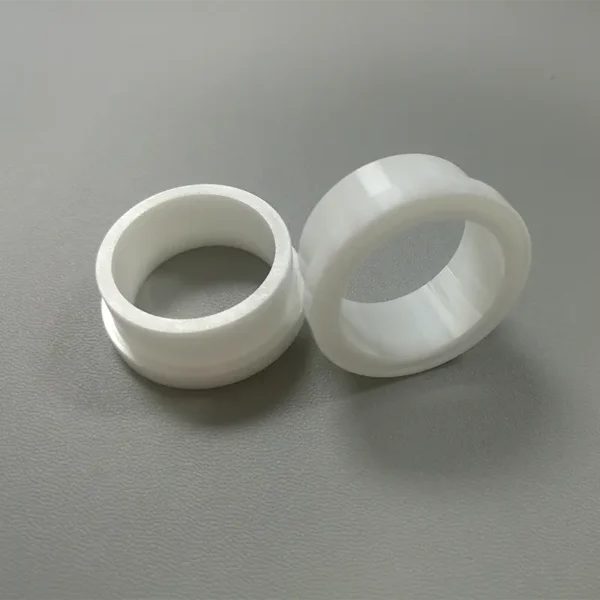


Specify the ring’s interface, machining datum, electrical role and thermal environment before comparing quotations. Porcecore can review the drawing and clarify which characteristics require controlled inspection.
Key Inquiry Requirements
Ring Function and Interface Geometry
Machinable ceramic rings often sit between other components, so the interface definition matters as much as the ring outline. Show outside and inside diameters, axial thickness, steps, grooves, counterbores, slots, and contact faces on a controlled drawing. Identify which surfaces locate, seal, insulate, space, or carry clamping contact, and establish datums that reflect the installed assembly.
Describe the mating parts and assembly sequence in the RFQ. A ring used as a spacer may have different priorities from one used around an electrode, fastener, shaft, or thermally isolated joint. Include clearances, contact patterns, insertion direction, retention method, and any removal constraints so the supplier can assess machinability and inspection access against the real interface.
Machining Strategy and Material Definition
The phrase machinable ceramic does not by itself define the material required for quotation. State the intended machinable glass ceramic family or request the supplier’s proposed designation, together with any color, surface, or process restrictions. If substitutions are acceptable, require explicit disclosure because machining behavior, electrical response, thermal behavior, and finishing practices can vary between material systems.
Ask how the proposed material will be processed into the specified ring, particularly where thin walls, narrow lands, interrupted profiles, or close mating surfaces are involved. The quotation should separate drawing requirements from process recommendations. This makes it easier to compare suppliers without treating a material label, a photograph, or a general machinability statement as a complete technical specification.
Dimensional Stability and Inspection
Inspection should focus on the dimensions that control assembly and function. Define bore and outside-diameter measurement, axial thickness, parallelism, concentricity or runout where relevant, step depth, groove location, and surface condition. Identify the reference temperature or inspection method only when necessary for a meaningful result, and avoid leaving critical ring geometry to an informal visual comparison.
For rings used in repeated assemblies, request a practical inspection record tied to drawing datums. Include checks for chips, cracks, edge damage, contamination, and handling marks on functional faces. If a surface finish or flatness requirement is important, specify its location and measurement method rather than applying an undifferentiated requirement to every surface.
Electrical and Thermal Context
If the ring provides electrical insulation, explain the neighboring conductors, contact pressure, voltage environment, cleaning method, and any exposure to moisture or process media. If it separates hot and cool parts, describe heat paths, contact areas, cycling pattern, and nearby materials. These inputs establish the questions a supplier must answer without turning the page into an unsupported performance guarantee.
Also define what the ring must not do in the assembly. It may need to avoid unwanted contact, particle generation, distortion, leakage paths, or interference with access for inspection. A concise application sketch can be valuable when the ring’s role is difficult to infer from a section view, especially where several concentric parts share the same envelope.
Building a Complete Ring RFQ
A useful package includes the ring drawing, material requirement, revision, annual or project context if available, assembly sketch, inspection plan, packaging expectations, and open technical questions. State whether machining marks, edge breaks, or protective features are controlled characteristics. Ask the supplier to identify assumptions about datum interpretation, material designation, process route, and measurement capability.
When reviewing quotations, compare the actual interface features first: bore relationship, locating faces, thickness control, edge condition, and traceable inspection. Then compare material disclosure, proposed process, packaging, and deviation handling. Keep the ring’s function visible throughout the review so a lower-complexity quotation does not appear equivalent merely because its outside profile looks similar.
Questions Before You Inquire
What should a machinable ceramic ring drawing show?
Show the complete radial and axial profile, including bores, steps, grooves, slots, edge treatments, locating faces, datums, and revision level. Add an assembly sketch when the ring’s electrical, spacing, sealing, or thermal role is not obvious from the part drawing.
Can a supplier select the machinable glass ceramic grade?
Only if the RFQ allows material selection. Ask the supplier to disclose the proposed designation and explain relevant trade-offs. If the application has fixed electrical, thermal, chemical, or dimensional requirements, define those requirements and require written approval for any substitution.
Which ring features usually need focused inspection?
Focus on dimensions that control mating and location: bore, outside diameter, axial thickness, concentric relationships, step or groove position, parallelism, and functional face condition. The drawing should identify datums and measurement methods so inspection results can be compared between suppliers.
Are machinable ceramic rings an inventory item?
This page does not represent stock, standard dimensions, or immediate availability. Treat the component as a drawing-led RFQ. Submit the required geometry, material definition, application context, inspection expectations, and packaging needs for a supplier review.
Send a Clear Component Brief
Share your drawing, quantity and application with Porcecore. Mark the requirements that are fixed and the questions that remain open.


Reviews
There are no reviews yet.