
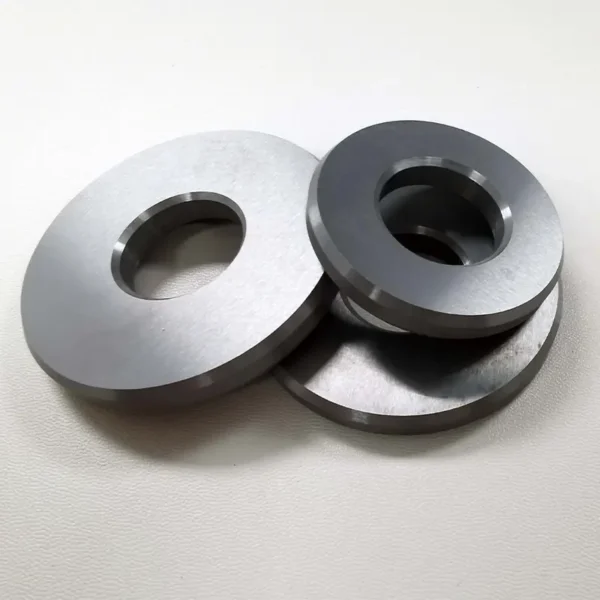


Use this page to prepare a clear inquiry for silicon nitride flat washers. Define the washer’s role, reference surfaces, assembly sequence and exposure conditions so prospective suppliers can compare the same requirement and identify suitable processing or finishing routes.
Key Inquiry Requirements
Define the washer’s mechanical role
A flat washer may distribute contact pressure, isolate adjoining materials, establish spacing or protect a surface from direct fastener contact. These functions can impose different priorities on the drawing. State whether the part is clamped, floating, repeatedly assembled or used as a permanent spacer, and identify which faces matter for seating. This context helps a supplier assess the geometry without assuming one universal washer design.
Describe the fastener relationship and load path in practical terms. Include the mating component materials, contact arrangement, assembly method and any concern about edge chipping, local stress or particle generation. If the washer sits inside a stack-up, show neighboring parts and datum references. A section view is often more useful than a nominal outside diameter and hole description alone when the interface is sensitive.
Build a complete drawing package
The drawing should identify outside and inside features, thickness, edge treatment, flatness or parallelism requirements, datum structure and any surface zones that must remain functional. Avoid relying on a catalog name to define the part. Mark critical-to-fit dimensions separately from dimensions that may be controlled through a broader manufacturing allowance, subject to engineering approval.
Include revision status, material designation, quantity for quotation and any approved alternatives. If the washer is part of a qualified assembly, provide the relevant mating drawing or interface excerpt under controlled document handling. Clarify whether dimensions apply before or after any finishing operation. These details let suppliers review manufacturability and return comparable questions rather than making silent interpretations.
Compare material and process proposals
Silicon nitride is a material family, not a complete procurement specification. Ask suppliers to identify the proposed grade or formulation, forming route and finishing approach, then compare those choices against the component’s load, temperature, electrical and chemical environment. Request supporting material information in a format that distinguishes typical data from release criteria and avoids treating marketing descriptions as guaranteed properties.
For thin rings or washers, processing history and handling can influence edge condition and dimensional consistency. Ask how the supplier manages shrinkage, machining reference surfaces, cleaning and protection during packing. If the application cannot tolerate chips, residue or surface damage, place those concerns in the acceptance criteria. A useful comparison considers evidence, inspection capability and fit to the drawing, not material name alone.
Plan inspection around function
Inspection should follow the washer’s actual job. Identify the dimensions that control hole clearance, fastener seating, stack height, alignment and adjacent-surface protection. Specify the measurement method, sampling expectation and report format where those records are required. If visual examination is important, define the relevant surfaces and defect categories instead of using an undefined request for perfect appearance.
Discuss how nonconformities will be handled before quotation. Clarify whether minor edge features, discoloration, handling marks or surface variation are acceptable, and which conditions are rejectable. For a critical assembly, consider first-article review or an agreed sample approval process. The goal is a shared inspection language that connects drawing requirements to assembly risk without inventing unsupported acceptance limits.
Make the RFQ decision-ready
A strong RFQ should combine the drawing, material family, application summary, annual or project quantity, inspection expectations and delivery destination. Add the operating environment, assembly notes and known constraints, but do not substitute broad claims such as high temperature or high wear for actual conditions. Suppliers need enough context to identify questions while keeping the final requirement under buyer control.
Ask for a quotation that separates tooling, processing, finishing, inspection and packaging assumptions where relevant. Request clarification of exclusions, drawing questions and proposed deviations before approval. If multiple washer variants are needed, provide a part-number schedule and indicate which dimensions or interfaces are shared. This structure makes technical and commercial comparisons more transparent without implying stock availability or a guaranteed supply arrangement.
Questions Before You Inquire
What should accompany an RFQ for silicon nitride flat washers?
Provide a controlled drawing, material family, application description, mating-part information, quantity assumptions and inspection requirements. Include the load path, assembly method and environmental exposure when they affect selection. A section view and marked critical features can prevent suppliers from interpreting the washer as a generic catalog part.
Should the washer drawing specify only material and dimensions?
No. Material and dimensions establish the basic identity, but the RFQ should also address datums, edge condition, surface requirements, inspection methods, cleanliness and packing concerns where relevant. Explain the washer’s function so suppliers can identify risks associated with seating, clamping, isolation or repeated assembly.
How can buyers compare different supplier proposals?
Compare the proposed material designation, forming and finishing route, inspection evidence, assumptions and deviations against one controlled requirement. Separate typical material data from contractual acceptance criteria. Review how each proposal addresses edge integrity, dimensional control, cleaning and packaging, rather than selecting on the material name or headline claim alone.
Are standard washer dimensions suitable for every project?
Not necessarily. A standard profile may be acceptable for a simple interface, but ceramic washers can be sensitive to fit, contact stress and assembly details. Confirm the complete stack-up, clearance, seating surfaces and environmental conditions before adopting a standard size. A drawing review is preferable when the washer protects a critical interface.
Send a Clear Component Brief
Share your drawing, quantity and application with Porcecore. Mark the requirements that are fixed and the questions that remain open.


Reviews
There are no reviews yet.